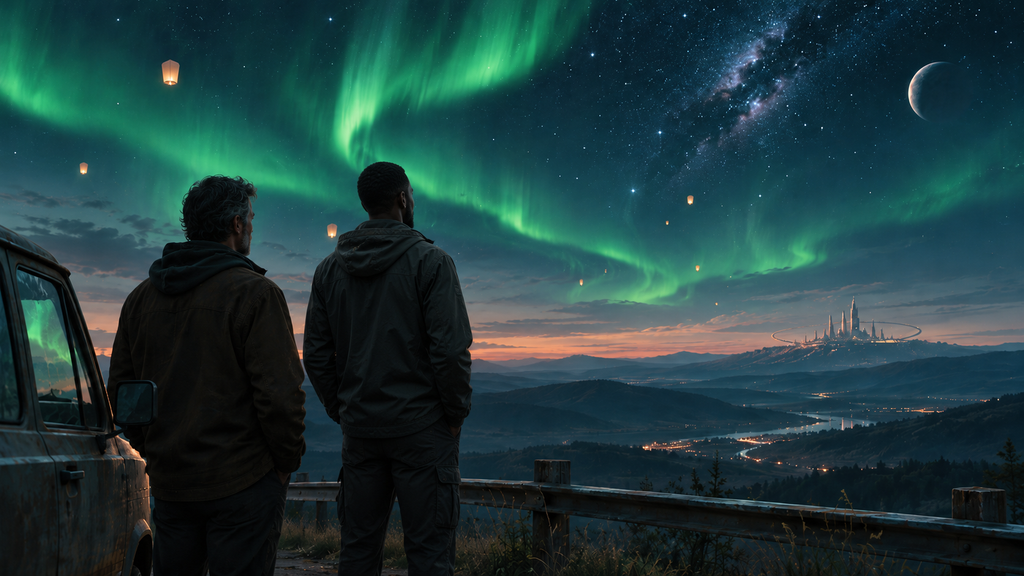
One of my surprise viewing pleasures of 2026 has been Lanterns, the HBO series based on DC’s Green Lantern universe.
I confess I only started watching it because Mark wanted to. He’s a lifelong fan of the superhero genre, while I know virtually nothing about the Green Lantern universe. I went in with no expectations whatsoever.
I’m now one episode short of finishing the first season, and considerably more invested than I ever expected to be.
And no spoilers here, I promise.
When Knowing What’s Coming Doesn’t Matter
One of the occupational hazards of writing fiction for a living is that I tend to see plot developments coming long before they’re revealed. After decades of constructing stories, I have a fairly well-developed sense of their architecture. It’s difficult to switch that off, even when I’m sitting on the sofa with a cup of tea.
I anticipated just about every major turn in Lanterns, but I can’t reasonably hold that against the series. I suspect most viewers wouldn’t have found the developments nearly as predictable as I did.
More importantly, knowing what was coming didn’t diminish my enjoyment.
There’s a considerable difference between wanting to know what happens next and wanting to see what happens to the people you’ve become invested in.
Lanterns gave me the latter in abundance.
Backstories That Actually Do Something
The character arcs were exceptionally well handled, particularly those of veteran Lantern Hal Jordan (Kyle Chandler) and his prospective successor, John Stewart (Aaron Pierre).
John’s backstory was especially impressive. As it began to unfold, I was getting distinctly uncomfortable. I thought the writers were heading into some very dark territory, and I wasn’t sure I wanted to go there with them.
What ultimately emerged was still fairly grim. But when the full story became apparent, it shifted my understanding of everything I’d already seen into an entirely different perspective.
The facts hadn’t changed. My understanding of them had.
That’s sophisticated storytelling. Backstory can be little more than an explanation for why a character behaves the way they do. Here, it fundamentally altered how I perceived the character, his relationships and his choices.
A Universe Bigger Than the Screen
Perhaps the most surprising aspect of Lanterns is how little traditional superhero derring-do there is.
There are relatively few grand action sequences, elaborate sets or extravagant special effects. Much of the story plays out in decidedly ordinary terrestrial surroundings, and at times the series feels more like a crime thriller than a superhero adventure.
Yet it never stopped feeling like a fully formed superhero story, with an enormous universe extending beyond the edges of the screen.
As a science fiction writer, I particularly appreciated this.
Creating a sense of scale without constantly putting that scale on display is considerably harder than it might appear. The audience has to believe in civilizations, institutions, histories and conflicts they may never actually see. The characters’ attitudes, assumptions and concerns have to carry the weight of that larger universe.
It’s an approach particularly well suited to television, where even generous production budgets have their limits. And when it’s done well, the unseen universe can feel considerably larger than one the special effects department has painstakingly rendered for us.
Laura Linney was particularly effective in this respect. She has a relatively small role as one of the Guardians of the Universe, but her performance includes just enough subtly odd touches that you never quite forget you’re watching an alien, no matter how human she looks.
No elaborate prosthetics required. Just a very good actor making some very interesting choices.
Something for the Fans, Too
I can’t comment intelligently on how closely the series adheres to the established Green Lantern canon, although Mark assures me that the writers haven’t taken too many liberties with it.
Even with three different Green Lanterns in play at one point!
What I can say is that my complete ignorance of the source material wasn’t a handicap. The series worked perfectly well for me on its own merits, which is something not every franchise production manages these days.
I still have the final episode to watch, but I’m already hoping for a second season.
If you’ve been suffering from a touch of superhero fatigue, Lanterns might be worth a look. It’s a reminder of how much the genre can accomplish when it puts its characters ahead of its fireworks.
And I’d love to know: have you watched a science fiction or superhero series recently that turned out to be considerably better than you expected?
I’m always on the lookout for the next unexpected gem.

Latest releases:
Rogue Star
The Woman Who Remembered Yesterday
Quiet Like Fire — Aurealis Award Finalist for Best SF Novella!
Solar Whisper