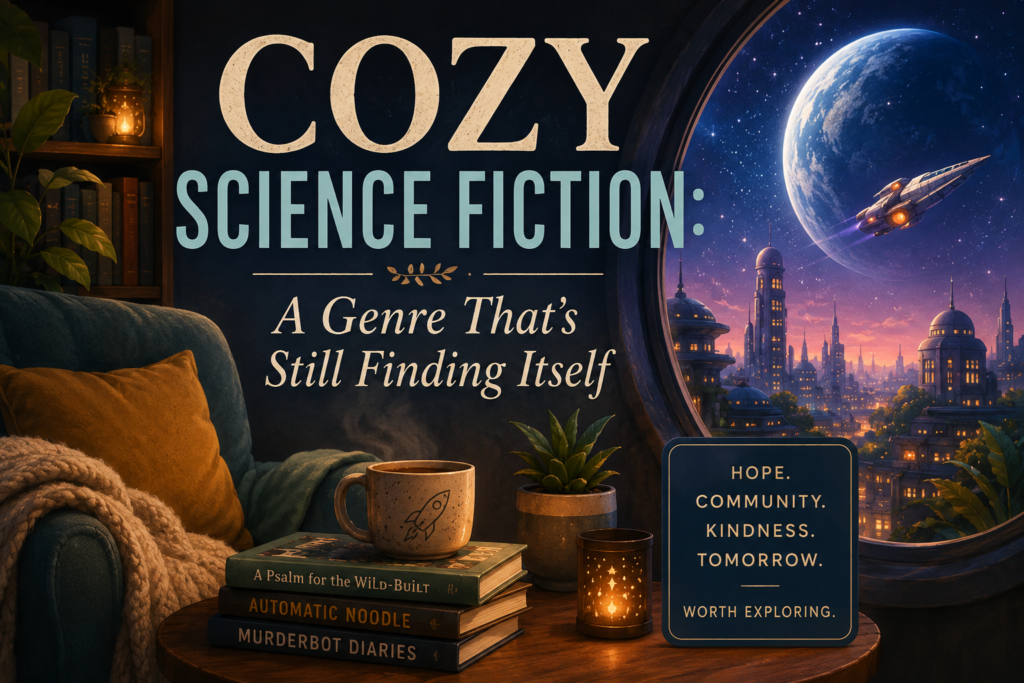
I’ve been immersed in what people are calling cozy science fiction lately. I’ve just finished Automatic Noodle, which I thoroughly enjoyed, and I’ve also been spending time with Becky Chambers’ A Psalm for the Wild-Built. Both left me with that satisfying feeling that comes from spending time in the company of good people trying to do the right thing.
But here’s the interesting thing: what exactly is cozy science fiction?
The answer turns out to be a little fuzzy. Unlike cozy mysteries or even cozy fantasy, cozy SF isn’t an established publishing category. You won’t find a dedicated shelf for it in most bookstores, and retailers don’t have a “Cozy Science Fiction” category to browse. At the moment, it’s less an official genre than an ongoing conversation among readers.
And that’s part of what makes it so interesting.
What Makes Science Fiction “Cozy”?
The obvious assumption is that cozy science fiction is simply science fiction with low stakes.
Sometimes that’s true. But I don’t think that’s the defining characteristic. To me, cozy SF is more about emotional focus than plot scale. These are stories that put people, relationships, community, kindness, and hope at the centre. The science fiction is still there—robots, artificial intelligence, spaceships, distant worlds—but the story is more interested in how people live than how they fight.
The conflict is often personal rather than galactic. Characters build communities instead of empires. They solve problems through cooperation rather than overwhelming force. They find purpose, belonging, and friendship.
That’s the heart of it for me.
Enter Hopepunk
Another term you’ll often encounter alongside cozy SF is hopepunk.
Hopepunk isn’t a genre so much as a storytelling philosophy. It argues that hope, compassion, and kindness aren’t signs of weakness or naïveté. They’re choices. Sometimes they’re even acts of quiet rebellion.
That philosophy seems to run through much of the best cozy science fiction. The stories acknowledge that the universe can be difficult, unfair, or lonely, but they refuse to conclude that cynicism is the only sensible response.
Instead, they suggest that people can still choose generosity. Communities can still be built. Tomorrow can still be better than today.
I find that deeply appealing.
The Grey Areas
Because cozy SF is still finding its identity, there are plenty of books that don’t fit neatly into the category.
Take Martha Wells’ Murderbot Diaries.
Are they cozy? Many readers would probably say no. They’re packed with danger, action, shootouts, conspiracies, and the endlessly fascinating politics of the Corporate Rim.
Yet I suspect many of us read them for exactly the same reasons we read cozy SF.
At its heart, Murderbot is about belonging. It’s about someone discovering friendship almost in spite of themselves, finding people worth protecting, and slowly building trust. Those emotional threads feel very much at home beside books like Automatic Noodle or A Psalm for the Wild-Built, even if the action level is considerably higher.
That’s one of the pleasures of exploring a genre that’s still emerging. The edges are wonderfully blurry.
Why It’s Resonating
I don’t think it’s a coincidence that cozy science fiction is becoming more visible now.
For years, science fiction has given us plenty of dystopias, collapsing civilizations, and grim futures. Those stories certainly have their place. But many readers seem to be looking for futures where humanity hasn’t lost its capacity for kindness.
Not because those futures are unrealistic. Because they’re aspirational.
Why I’m Enjoying It
My own novels aren’t cozy. I like writing big space operas with genuinely high stakes. Galaxies have a habit of getting themselves into trouble.
But what I appreciate in cozy science fiction are the qualities that have always mattered to me as a reader: optimism, capable people, enduring friendships, communities worth protecting, and the belief that even in difficult circumstances, people can choose to become better versions of themselves.
Those ideas aren’t exclusive to cozy SF. They’re simply given centre stage.
Perhaps that’s why this emerging corner of science fiction feels so refreshing. It’s reminding us that stories don’t need to be cynical to be compelling, and that hope can be every bit as powerful as fear.
I’m curious to see where the genre goes from here.
And I’d love to hear your recommendations.
What books would you put under the cozy SF umbrella? Which ones embrace the spirit of hopepunk? And which stories live in that intriguing grey area where they don’t quite fit the label, but somehow belong in the conversation anyway?
Now available for pre-order:
Rogue Star
Latest releases:
The Woman Who Remembered Yesterday
Quiet Like Fire — Aurealis Award Finalist for Best SF Novella!
Solar Whisper
Try E. M. Foner. I think _Date Night on Union Station_ was the first book he published. The current blurb on Amazon says, “Remember when science fiction was about a future you wouldn’t be terrified to live in?”
The title and cover may be a little misleading. He said something one time about needing to write in a more popular and well-defined genre to be more successful. He’s one of my favorite authors – it looks like I have 54 of his ebooks and 15 of his audiobooks in my library.
I remember that story. The cover caught my eye every time I saw it. But then it seemed to disappear. I must look it up again.
Thanks!
Cam
I think I’ve changed the covers on the early Union Station books five times since Date Night came out in 2014. If you’re interested in trying one of my books, shoot me an email and I’ll send you an Amazon gift for one of the more recent series, like, “The Good Apocalypse.” I write without wars, bad guys, or high drama, but I don’t know about the cozy label, even though people, aliens, and AI in the stories seek relationships. My interest has always been more in the realm of what if, proposing and working with different economic, technical, and governmental systems. Maybe the happy endings make them cozy, I don’t know.
Your stories certainly sound like they have a cozy vibe to me.
It’s a generous offer you’re making. I hope my readers at least reach out and thank you for it!
Thanks for stopping by.
Cam.
Cam,
The offer was for you:-)
E. M.