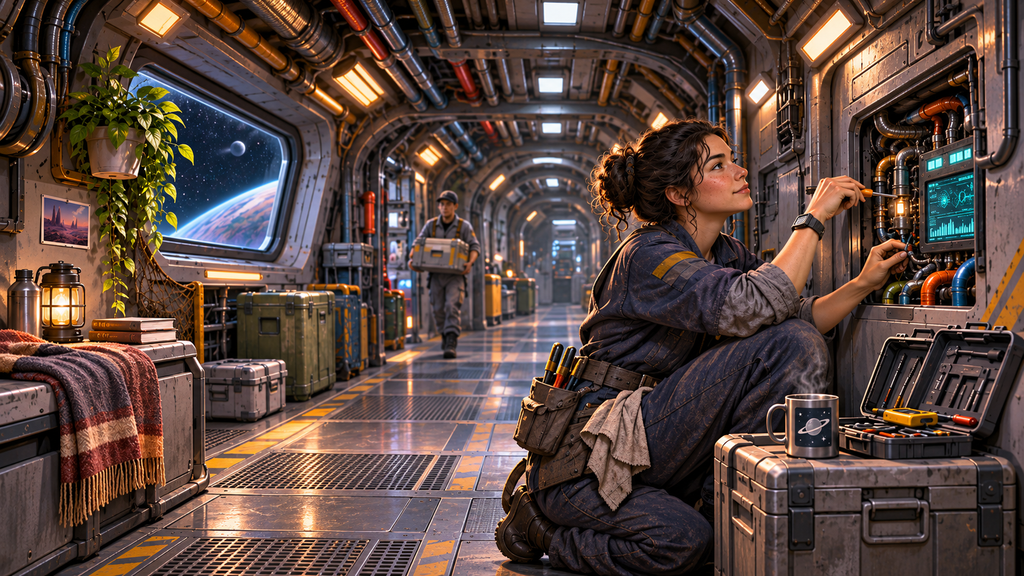
Science fiction is full of extraordinary people. Starship captains making impossible decisions. Scientists who discover the secrets of the universe. Rebels who bring down galactic empires. Explorers who boldly go where no one has gone before.
But here’s a question: Who cleans the starship? Who maintains the life-support systems, prepares the meals, repairs the plumbing, and makes sure there’s enough toilet paper for a five-year mission?
Because somebody has to.
And in the vacuum of space, the person responsible for keeping the toilets working might be considerably more important to your immediate survival than the captain.
The Invisible People of the Future
We live in a world that depends on millions of people whose work we barely notice. The people who keep the electricity flowing, the water clean, the grocery shelves stocked, and the roads passable. The technicians, cleaners, mechanics, administrators, and maintenance crews who make civilization possible. We tend to notice them only when something goes wrong.
Most of these people will never appear in history books. Nobody will erect statues to honour them. A generation or two from now, their names may be remembered only by their descendants, if at all. Yet their lives are no less rich, complicated, or meaningful than those of the famous people whose names survive for centuries. And their stories are often the ones that resonate most deeply with us, because they’re so much like our own.
Science fiction has a similar blind spot. We’re fascinated by the people who build civilizations, discover new worlds, and fight interstellar wars. But once those civilizations exist, somebody has to keep them running. And the more technologically complex a society becomes, the more essential its maintenance workers are likely to be.
Consider an enormous space station housing a hundred thousand people. Its commander might be responsible for the entire installation, but the person who detects a failing atmospheric processor before it kills everyone aboard has just saved a hundred thousand lives.
No dramatic speeches. No medals. Possibly no one even notices. Just another Tuesday on the maintenance shift. Yet how often do we get to read that person’s story?
Star Trek Goes Below Decks
Star Trek has always been particularly fond of exceptional individuals. Its captains are legendary. Its senior officers possess remarkable abilities, and even its engineers seem capable of solving impossible problems with a tricorder and a few minutes before the ship explodes. But the franchise has occasionally looked beyond the bridge.
The 1994 Next Generation episode “Lower Decks” followed junior officers whose concerns were rather different from those of Picard and his senior staff. They had friendships, ambitions, insecurities, and careers to worry about. The fate of the Federation wasn’t necessarily their immediate concern.
More recently, Star Trek: Lower Decks turned that perspective into an entire series. Interestingly, it was animated and comedic. Perhaps that’s just how the creators wanted to tell those stories, but I do wonder whether there was an assumption that audiences wouldn’t take the adventures of junior officers quite as seriously as those of a starship captain.
And even then, the characters frequently find themselves involved in extraordinary adventures. Apparently, it’s difficult to escape the gravitational pull of heroism.
Ordinary People Make Extraordinary Stories
One of the finest writers of ordinary people was Nevil Shute. His characters were often unremarkable people dealing with circumstances they hadn’t sought and couldn’t control. Jean Paget, in A Town Like Alice, finds herself caught up in the horrors of war, but she’s not a soldier or a political leader. She’s an ordinary young woman whose courage and resourcefulness emerge from her circumstances.
In What Happened to the Corbetts, Shute examines the effects of war through the experiences of an ordinary family trying to survive. The enormous historical events are almost secondary to the practical problems of keeping a family safe. And in the heartbreaking Requiem for a Wren, he tells a deeply moving story of an ordinary woman’s wartime experiences and their consequences.
Shute understood something that applies equally well to science fiction: an ordinary person’s life doesn’t have to change the course of history to make a compelling story. Readers recognize themselves in these characters. We understand their frustrations, their hopes, their mistakes, and their small triumphs. The circumstances might be unfamiliar, but the emotional experiences aren’t. And that familiarity can be especially powerful when the story takes place in an unfamiliar world.
When Ordinary Lives Become the Story
Some science fiction writers have embraced this approach. Becky Chambers is an obvious example. In The Long Way to a Small, Angry Planet and her other Wayfarers novels, the characters aren’t necessarily destined to reshape the galaxy. They’re people with jobs, relationships, personal problems, and aspirations. Their lives matter, not because they save civilization, but because they’re living those lives.
Adrian Tchaikovsky offers a particularly interesting variation in Service Model, whose central character begins as a robot valet named Charles. Eventually renamed Uncharles, he exists to serve. His purpose is so thoroughly defined by his usefulness to others that his own identity becomes an intriguing question.
And then there’s the growing popularity of cozy science fiction, which often concerns itself with the smaller, quieter experiences of living in a speculative world.
Not every story needs an interstellar war. Sometimes the challenge of running a business, building a community, repairing a ship, or finding somewhere to belong provides more than enough material. These stories aren’t necessarily less ambitious than traditional space opera. They’re simply interested in a different scale of human experience.
Does Everyone Have to Be a Hero?
There’s a subtle distinction here that I find fascinating. We can write stories in which ordinary people are unexpectedly thrust into extraordinary situations. Science fiction has been doing that for decades. But what about stories in which ordinary people are allowed to remain ordinary? Where competence matters more than destiny? Where solving a practical problem is an achievement in itself? Where someone can have a meaningful life without becoming famous, powerful, or historically significant?
After all, most of us aren’t saving the world. We’re working, loving, arguing, making mistakes, solving problems, and trying to get through the week with some degree of dignity intact. There’s drama in those lives. Humour, too. And courage, sacrifice, loyalty, ingenuity, and all the other qualities we associate with great stories.
Why should those things become less interesting simply because the characters happen to live on a spaceship? In fact, putting ordinary people into extraordinary environments might make their experiences even more compelling.
Imagine trying to deal with an irritating coworker when you can’t leave the ship for another eighteen months. Or discovering that the person responsible for maintaining the oxygen supply has decided to quit. Suddenly, the mundane becomes rather important.
Making the Future Feel Like Home
There’s another reason I think stories about ordinary lives in science fiction are important. They make the future feel real.
For some readers, science fiction can seem like an endless succession of space battles, temporal paradoxes, existential threats, and civilizations on the brink of destruction. Those stories can be wonderful, but they don’t necessarily make the future seem like somewhere you’d want to live.
When we read about ordinary people going about their lives on a spaceship or a distant planet, something interesting happens. The extraordinary setting becomes normal. The spaceship stops being merely a vehicle for adventure and becomes someone’s home. The alien planet isn’t just a dangerous frontier to be conquered. It’s a place where people work, raise children, fall in love, argue with their neighbours, and wonder what to have for dinner. The future becomes somewhere we can imagine ourselves living.
And for readers who aren’t particularly interested in galactic wars or complicated time paradoxes, these stories offer another way into science fiction. They demonstrate that the genre isn’t exclusively about grand adventures and world-shattering events. It’s also about people.
The Future Belongs to Everyone
I don’t think science fiction needs fewer captains, explorers, or galaxy-saving heroes. There’s plenty of room for all of them. But I’d like to see more stories about everyone else. The technicians who keep the ships flying. The cooks who feed the crews. The people who build communities on distant planets, raise families aboard space stations, and do their jobs while history unfolds somewhere else. Because if humanity ever does spread across the stars, most of us won’t be commanding starships or negotiating peace treaties with alien civilizations. We’ll be doing the things people have always done: working, living, loving, and keeping the machinery of civilization turning.
Our names probably won’t appear in the history books of the future, either. But that doesn’t mean our lives won’t be worth remembering.
Perhaps the greatest achievement of science fiction isn’t always imagining the extraordinary things humanity might accomplish. Sometimes it’s imagining what an ordinary Tuesday might look like, a thousand years from now.
Someone will still have to fix the plumbing.
And I’d quite like to hear their story.

Latest releases:
Rogue Star
The Woman Who Remembered Yesterday
Quiet Like Fire — Aurealis Award Finalist for Best SF Novella!
Solar Whisper