We have made a terrible mistake.
We taught machines to write novels before we taught them to fold fitted sheets.
Artificial intelligence can write computer code, translate languages, analyze medical images, summarize enormous documents, compose music and produce a perfectly respectable explanation of quantum mechanics for a twelve-year-old.
Meanwhile, if I want the laundry folded, somebody in this house still has to fold the laundry.
I would like to lodge a complaint with the future.
This Is Not What Science Fiction Promised Me
Science fiction has been promising us domestic robots for decades.
Robots were supposed to handle the tedious stuff. Cleaning. Cooking. Carrying things. Fetching things. Putting things away. All the endless maintenance required to stop a house gradually reverting to its natural state of chaos.
The humans, meanwhile, would be freed for more interesting pursuits.
Instead, we seem to have automated the interesting pursuits first.
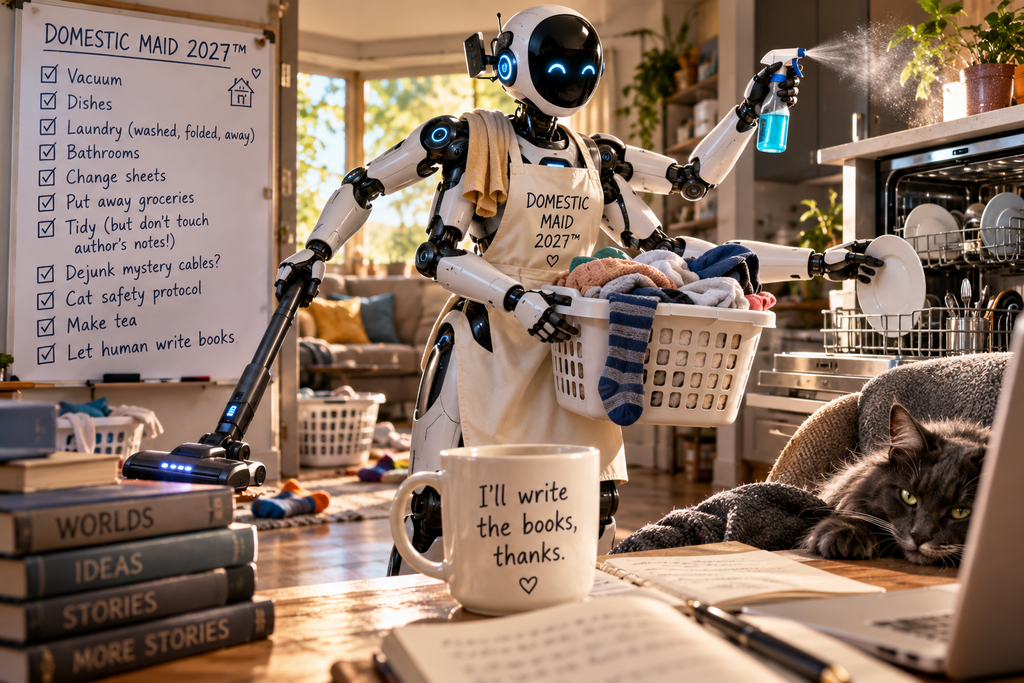
I don’t want AI to write my books. I want AI to do everything else so I can write my books.
Give me a machine that cleans the bathroom. Changes the sheets. Folds the laundry. Empties the dishwasher. Vacuums under the furniture without choking to death on cat hair. Clears out the junk drawer and makes an executive decision about the three mystery cables we’ve been keeping since 2009.
I’ll write the books, thanks.
And what makes this particularly galling is that the robots are already out there.
Have You Seen What Industrial Robots Can Do?
Figure, (that’s the actual name of the company, not me falling asleep at the keyboard!) one of the companies developing humanoid robots, recently demonstrated its Figure 03 robot autonomously sorting parcels.
This isn’t an old-fashioned industrial robot arm performing exactly the same movement over and over again.
The robot has hands. It picks up soft, deformable packages in different orientations, manipulates them and places them correctly for a scanner. It has to see what it is holding and adjust what it does accordingly.
You can see a video of Figure 03 sorting packages here.
It’s fascinating. It’s also infuriating. Because if you can do that, why can’t you come to my house and put away the groceries?
There are legitimate technical reasons.
A factory or sorting facility is a relatively controlled environment. The robot knows where it is. The workspace has been designed for the job. The range of objects it encounters is limited. Even when the parcels differ wildly, they’re still parcels.
A house is anarchy.
There is a coffee cup on the desk, a sock half under the bed, a book on the sofa and a cat sitting precisely where you need to put your foot.
The robot has to understand that the cup goes to the kitchen, the sock goes into the laundry, the book probably belongs on a shelf and the cat emphatically does not belong in a cupboard.
And then there are the things it must learn about one particular household.
That’s an important document. That’s recycling. That’s not recycling even though it looks like it should be. Those books are waiting to be shelved. Those books are deliberately stacked there. Don’t throw out that scrap of paper because somebody wrote a phone number on it.
And for the love of all that’s holy, don’t “tidy” the author’s notes.
A domestic robot needs much more than dexterous hands.
It needs judgment.
Oddly enough, we may finally have invented that part.
Perhaps We Built the Brain First
For years, the obstacle to the general-purpose household robot wasn’t merely mechanical.
We have been building remarkably capable robot arms for industry for decades. What we couldn’t easily build was a machine that could look at the glorious disorder of an ordinary human environment and understand what it was seeing.
That is precisely where modern AI becomes interesting.
Machine vision can identify objects. AI systems can interpret instructions and context. Robots are getting better at manipulating unfamiliar objects rather than merely repeating programmed movements.
Perhaps science fiction wasn’t wrong about the robot maid.
Perhaps it simply got the order of invention wrong.
We couldn’t build Rosie until we’d built Rosie’s brain.
But there’s another reason the really impressive robots appeared in factories before they appeared in our kitchens.
Money.
Nobody Puts Unpaid Work on the Balance Sheet
If a company buys an expensive robot, it can calculate the return.
The robot costs this much. It can work this many hours. It will increase production by this amount or eliminate this many paid labour hours. It will pay for itself in four years.
Easy.
Domestic labour is different.
Someone has to wash the dishes, clean the bathroom, change the sheets, shop for groceries, cook meals, wash clothes, fold clothes, put clothes away, vacuum, mop, tidy, sort, organize and perform the approximately nine million other tiny jobs involved in maintaining a household.
But when we do those jobs ourselves, nobody sends us an invoice.
That labour is economically invisible.
Historically, much of it has also fallen disproportionately on women. And although the division of domestic work has changed considerably, the difference hasn’t disappeared.
Statistics Canada’s 2015 Time Use Survey found that women aged 25 to 54 spent an average of 3.9 hours per day on unpaid work as their primary activity, compared with 2.4 hours for men.
Looking specifically at housework, women averaged 2.8 hours a day and men 1.9 hours—a difference of 6.3 hours every week.
The type of work differed, too. Women were more likely to do the routine, repetitive jobs—cooking, cleaning, laundry and shopping. Men were more likely to do episodic jobs such as repairs, mowing the lawn and gardening.
The data is older now, but the point isn’t really about who did precisely how many minutes of laundry in 2015. It’s that all those hours of domestic labour are real work. When labour doesn’t have a wage attached to it, there is less obvious economic pressure to replace it.
Factories have an immediate financial incentive to spend millions developing robots that sort parcels.
Nobody is paying me by the hour to sort the laundry.
From the household’s perspective, though, those hours are not free at all. They’re pieces of a life.
And That’s Not Even All the Work
There is another problem with counting domestic labour.
A surprising amount of it doesn’t look like work at all.
Statistics Canada pointed out that time-use surveys don’t adequately capture the mental and organizational work involved in running a household: planning meals, making appointments, arranging repairs and deliveries, keeping track of family commitments and all the other tiny acts of coordination that keep life moving.
That work is largely invisible until nobody does it. In other words, the job isn’t merely doing the laundry. It’s noticing that the laundry needs doing.
It’s realizing you’re nearly out of detergent. It’s remembering that the good shirt needs washing before Thursday. It’s knowing which clothes can’t go in the dryer.
It’s noticing that someone has left a tissue in a pocket before the entire load emerges looking as though it has been caught in a small indoor snowstorm.
That’s the robot I want. Not another appliance waiting patiently for a human being to organize the job and press Start. I want the machine that notices.
How Much of a Life Goes Into Housework?
This is the part that makes me slightly wild-eyed whenever I think about it.
Ten minutes here. Twenty minutes there. Half an hour folding laundry. Fifteen minutes unloading the dishwasher. An hour making dinner and another chunk of time cleaning up afterward.
None of the individual jobs looks enormous. But they happen again tomorrow. And the next day.
And the day after that.
Technology has certainly helped. Washing machines, dryers, dishwashers and vacuum cleaners were transformative inventions. But notice what most domestic technology does.
It automates one tightly defined task.
The washing machine washes the clothes. It doesn’t notice the hamper is full, collect the clothes, sort them, run the appropriate loads, transfer them to the dryer, fold everything and put it away.
The dishwasher washes dishes. Somebody still has to load and unload it.
The robot vacuum cleans the floor, provided the floor has first been prepared for the robot vacuum and nobody has left something lying around that will choke it.
What I want is not another appliance. I want a general-purpose domestic worker.
Domestic Maid 2027™, Please
And suddenly, for the first time, that doesn’t seem completely ridiculous.
We have robots with increasingly human-like hands. We have machines that can recognize and manipulate unfamiliar objects. We have AI that can understand ordinary language and increasingly understand visual environments.
We have enormous amounts of money pouring into general-purpose robotics.
All the pieces are beginning to creep toward one another.
I’m not expecting Domestic Maid 2027™ to arrive next Christmas for $299.99 with free shipping.
But I am beginning to suspect that the domestic robot may finally move from the category of “science-fiction technology” into “hideously expensive early-adopter technology” and eventually into “ordinary appliance.”
I hope so.
Because we’ve already automated a great deal of the work humans actually want to do.
Now let’s automate the drudgery.
I don’t need a machine to imagine worlds for me. I need one that notices the dishwasher is clean, empties it without being asked, and then goes upstairs and folds the towels.
Technology industry: You know where to find me.

Now available for pre-order:
Rogue Star
Latest releases:
The Woman Who Remembered Yesterday
Quiet Like Fire — Aurealis Award Finalist for Best SF Novella!
Solar Whisper
______
Sources
Statistics Canada, Time use: Total work burden, unpaid work, and leisure (2018), using data from the 2010 and 2015 General Social Surveys on Time Use:
https://www150.statcan.gc.ca/n1/pub/89-503-x/2015001/article/54931-eng.htm
Figure 03 package-sorting demonstration:
https://www.reddit.com/r/robotics/comments/1s22tt5/new_video_of_figure_03_autonomously_sorting/