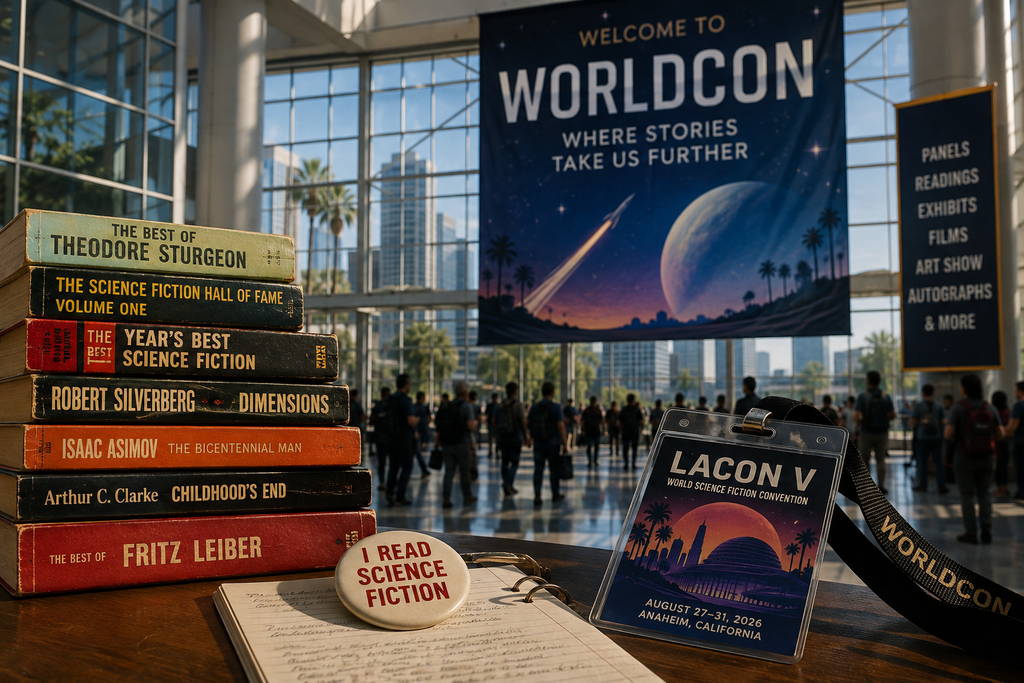
Worldcon starts tomorrow. And I have never been to one.
This might seem a little odd for someone who has spent a substantial portion of her life reading, writing and publishing speculative fiction. Surely Worldcon is where my people are?
Well, yes. And perhaps not quite in the way you might think.
I Read Science Fiction
I grew up in the Western Australian countryside, long before the internet made geography largely irrelevant to anyone with an obsessive interest and a modem. My relationship with science fiction wasn’t social. It couldn’t be.
I read.
I read the old anthologies of classic science fiction. I read Asimov and Clarke and Heinlein and Bradbury and dozens upon dozens of writers whose names I encountered first in battered collections and fat anthologies. One story led to another writer, which led to another book, which led to another idea.
That was how I found science fiction.
There was no community attached to it, at least not one I knew about. No conventions. No panels. No late-night conversations in hotel bars. No debates about Hugo voting or convention bids or who was going to be Guest of Honor next year.
There were books. Lots and lots of books. I was a geek.
I wasn’t, in the particular sense the word has acquired within the science-fiction community, a fan. I didn’t know there was a difference.
Then There Is Fandom
I’ve brushed up against the edges of science-fiction fandom many times over the years. It’s difficult not to, when you’ve been involved with speculative fiction for long enough. But always peripherally.
And from that position, I’ve gradually realized that fandom isn’t simply a collective noun for people who enjoy science fiction. It’s a culture.
It has history. Traditions. Institutions. Vocabulary. Customs. Arguments that began long before you arrived and friendships that have lasted even longer. People have worked on conventions together, travelled to conventions together, served on committees, organized bids, voted, volunteered, debated, celebrated and occasionally fallen out spectacularly with one another.
They know one another. Or they know someone who knows someone. Or they know of one another. There are generations of relationships layered on top of relationships.
For someone encountering it for the first time, I suspect that might be one of the biggest surprises. You thought you were going to a science-fiction convention. It turns out you’ve entered a small country.
The Invisible Country
Worldcon is particularly fascinating in this respect because it has been around for a very long time. The first World Science Fiction Convention was held in New York in 1939. Think about that for a moment. People were gathering specifically as science-fiction fans before the Second World War.
The convention has moved from city to city and country to country ever since, with interruptions and transformations along the way, while generations of fans have carried its traditions forward.
Worldcon isn’t run by a permanent corporation that sweeps into a city each year with branded trucks and a professional events team. Individual Worldcons are organized by fans. Future locations are bid for and selected. Volunteers do enormous amounts of the work. The Hugo Awards themselves are tied to Worldcon membership.
There is infrastructure here, certainly. But beneath the infrastructure is community. And communities develop shorthand.
If you’ve ever married into a large, close family, you’ll know the sensation. Everyone else understands why Uncle George’s remark about the potato salad is hysterically funny. Nobody thinks to explain it because they’ve all known the story for twenty-three years. While you are sitting there wondering what on earth is wrong with the potato salad.
Fandom, viewed from the outside, can sometimes look a little like that.
Reader, Geek, Fan
This is where I’ve come to appreciate a distinction I didn’t understand when I was younger. You can love science fiction without participating in fandom.
You can know the literature. You can have strong opinions about it. You can adore particular writers, argue about books, understand the history of the genre and spend an unreasonable percentage of your disposable income acquiring more of it.
You can even write science fiction yourself.
None of that automatically makes you part of fandom in its older, more specific sense. Fandom requires participation. It is social in a way that reading fundamentally isn’t.
My own path into science fiction was intensely solitary. A book, a chair and enough time to disappear somewhere else for a few hours were all I needed. And perhaps because I began that way, that is still where science fiction lives for me most powerfully. In the story.
In the moment when a writer introduces an idea so enormous that you have to stop reading for a second. In discovering a world that didn’t exist five minutes ago and now, somehow, does. In finishing a story and realizing that the furniture inside your head has been rearranged.
That was my science-fiction community before I knew communities existed. The writers spoke. I listened. Then I went looking for the next book.
If This Is Your First Worldcon
LAcon V, the 84th World Science Fiction Convention, begins tomorrow in Anaheim. Thousands of people will arrive carrying decades of shared history between them.
Some will have been attending Worldcons longer than other attendees have been alive. Some will know exactly how everything works. They’ll recognize names, traditions and references instantly.
And some people will be walking through the doors for the very first time. Perhaps because they love science fiction. Perhaps because they read the books. Perhaps because, somewhere along the way, they discovered that there is an entire community built around this thing they’ve loved privately for years.
If that’s you, I can’t give you advice about how to do Worldcon. I’ve never been. But I can tell you this:
If everyone appears to know everyone else, you’re probably not imagining it. If people use terms you don’t recognize, there may be decades of history behind them. If you occasionally feel as though you’ve arrived halfway through a conversation, you probably have.
That doesn’t mean the conversation isn’t for you. It means you’ve discovered that science fiction has something beyond the stories themselves: an old, complicated, interconnected culture created by people who cared enough about those stories to find one another.
I somehow missed that part. Growing up in the Western Australian countryside probably had quite a lot to do with it. Instead, I read. And read. And read some more.
I became a geek, rather than a fan.
All these years later, I’m still standing somewhere near the edges of fandom, looking in with curiosity at this strange little country that grew up around the literature I love. Which seems appropriate, really. Science fiction has always been about encountering alien cultures.
Sometimes you don’t even have to leave Earth to find one.
Now available for pre-order:
Rogue Star
Latest releases:
The Woman Who Remembered Yesterday
Quiet Like Fire — Aurealis Award Finalist for Best SF Novella!
Solar Whisper