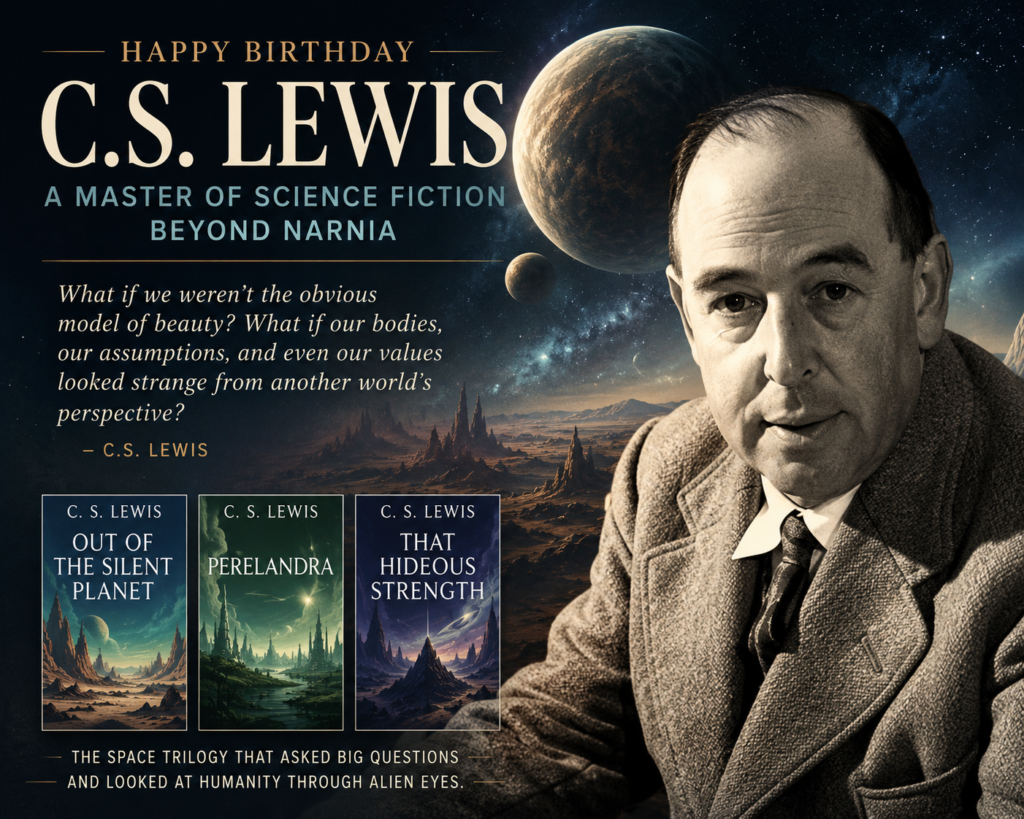
Today is C.S. Lewis’ birthday.
For many readers, that immediately conjures images of wardrobes, lions, witches, and snowy forests. Or perhaps thoughts turn to his friendship with Tolkien and the Inklings. Lewis is, quite rightly, remembered as one of fantasy’s giants.
But that’s not how I think of him. I think of his science fiction.
Long before I became a published science fiction author, I read Lewis’ Space Trilogy: Out of the Silent Planet, Perelandra, and That Hideous Strength. They were unlike anything else I had encountered. They weren’t trying to predict the future or explain technology. Instead, they used science fiction to ask philosophical questions about humanity, morality, culture, and our place in the universe.
One scene has stayed with me for decades.
My memory is imperfect, and I can’t swear which novel it came from, but I remember a character who had lived away from humanity for so long that, when he finally encountered another human being, he didn’t immediately recognize them as attractive—or even particularly human. Instead, he saw an awkward creature with oddly thick legs and a peculiar shape.
Whether my memory has polished the scene over the years almost doesn’t matter. The idea certainly belongs to Lewis.
He had an extraordinary ability to shift the reader’s perspective. Instead of assuming humanity was the standard by which everything else should be judged, he asked us to imagine seeing ourselves through alien eyes. What if we weren’t the obvious model of beauty? What if our bodies, our assumptions, and even our values looked strange from another world’s perspective?
That is a profoundly science fictional question.
Lewis wrote before we had spacecraft orbiting Mars, before we had photographs from the Moon, and long before modern planetary science overturned many of the assumptions that underpin Out of the Silent Planet. By today’s scientific standards, the astronomy is wildly inaccurate.
And yet the novels remain remarkably fresh. That’s because Lewis wasn’t really writing about Mars. He was writing about us.
Good science fiction often isn’t about predicting tomorrow’s technology. It’s about finding a new angle from which to examine humanity. Lewis understood that instinctively. His planets weren’t destinations; they were mirrors.
Perhaps that’s why his science fiction still resonates. The details may date, but the questions don’t.
So while the world celebrates C.S. Lewis as a master of fantasy today, I’ll quietly raise a glass to the writer whose science fiction taught me that one of the genre’s greatest strengths is its ability to make the familiar seem wonderfully, unsettlingly alien.
Happy birthday, C.S. Lewis.
Now available for pre-order:
Rogue Star
Latest releases:
The Woman Who Remembered Yesterday
Quiet Like Fire — Aurealis Award Finalist for Best SF Novella!
Solar Whisper