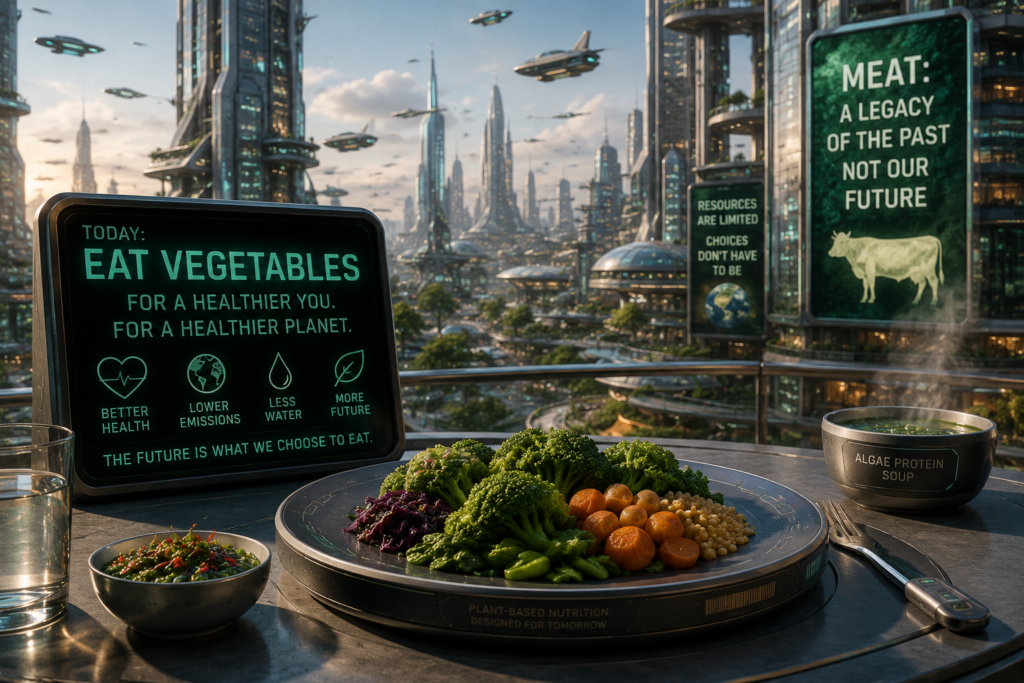
Today is National (USD) Eat Your Vegetables Day. Not exactly the sort of occasion that usually inspires a science fiction blog post.
Yet while wrestling with OneDrive recently, I stumbled across an old note from a discussion about two books that approach the same subject from completely different directions: T. Colin Campbell’s The China Study and Vaclav Smil’s Should We Eat Meat?
Campbell examines the health effects of animal-based diets. Smil looks at the broader economic, environmental, and political implications of feeding billions of people a meat-heavy diet.
One asks what meat consumption does to us.
The other asks what it does to civilization.
Science fiction, of course, asks a third question: What happens next?
The Long View
Science fiction writers have always been interested in trends. We take something happening today and ask where it might lead if it continues for decades or centuries.
The modern conversation around meat is interesting because several independent trends seem to be converging.
Health researchers continue to raise concerns about high consumption of red and processed meats. The World Health Organization classifies processed meat as carcinogenic to humans and red meat as probably carcinogenic to humans.
Environmental studies repeatedly identify livestock production as a major consumer of land, water, and energy resources.
At the same time, the world’s population continues to grow, and many developing nations naturally aspire to the same protein-rich diets that wealthier countries have enjoyed for generations.
Those trends don’t point to a simple future. In fact, they may point to a conflict.
Science Fiction Saw This Coming
Many science fiction novels quietly assume that traditional livestock production will eventually become impractical.
In The Caves of Steel, Asimov’s future citizens eat foods that bear little resemblance to what most of us would recognize as agriculture. Other writers imagined protein vats, algae farms, synthetic foods, cultured tissues, or highly engineered substitutes.
The details varied, but the underlying assumption remained remarkably consistent: as populations grow and resources become constrained, efficiency wins.
Whether those predictions prove accurate is another matter. Science fiction is better at identifying pressures than predicting outcomes. But the pressure is certainly there.
A cow requires enormous amounts of land, water, feed, and energy compared to many alternative protein sources. From a purely engineering perspective, future societies may eventually decide there are better ways to produce food.
Engineers tend to love efficiency.
Humans, however, are rarely that simple.
The Tobacco Question
The more I think about it, the more I wonder if the future of meat resembles the history of tobacco. Not because the products are equivalent, but because of the cultural shift.
Smoking was once considered normal, sophisticated, and widespread. Over time, health concerns accumulated. Regulations increased. Taxes rose. Public attitudes changed.
Smoking wasn’t banned. It became something different.
Could meat follow a similar path? Not disappear, or become illegal, but simply become less normal.
Perhaps future generations will eat meat occasionally rather than daily. Perhaps it becomes a luxury product. Perhaps cultured meat eventually becomes cheaper than raising livestock. Perhaps traditional meat acquires the same kind of niche status that cigars or vintage wines occupy today.
Or perhaps none of that happens. Human beings have a remarkable ability to cling to traditions they enjoy.
The More Interesting Trend
What I find especially intriguing is that the biggest shift may not be toward veganism. It may be toward flexibility.
Many people are already reducing meat consumption without eliminating it entirely. They are experimenting with alternatives, eating meat less frequently, or treating it as one option among many rather than the centerpiece of every meal.
That sort of gradual change rarely makes headlines, but history suggests that social transformations often occur exactly that way. I was taught in high school that a well-balanced meal consisted of “meat and three veg.” At the time, that seemed self-evident. Today, the idea of what constitutes a normal meal has already shifted. How much further might our food expectations change?
A Question for Science Fiction Readers
If Campbell is broadly right about the health impacts of heavy meat consumption, and Smil is broadly right about the sustainability challenges of feeding a growing planet, then science fiction may once again be pointing toward an uncomfortable question.
Not whether people will stop eating meat, but whether future societies will eventually decide that raising billions of animals for food is an expensive habit they can no longer justify.
Science fiction has imagined synthetic foods for decades. Perhaps the surprise won’t be that our descendants eat cultured protein grown in bioreactors. Perhaps the surprise will be that, on some future National Eat Vegetables Day, nobody quite remembers why eating vegetables was ever considered unusual enough to deserve a special day.
What do you think?
Will meat remain a permanent feature of human civilization, or is it destined to become one of those practices future generations view with curiosity and disbelief?

Now available for pre-order:
Rogue Star
Latest releases:
The Woman Who Remembered Yesterday
Quiet Like Fire — Aurealis Award Finalist for Best SF Novella!
Solar Whisper
Can’t imagine a world where I cannot eat meat whenever I feel like (3 times a week average).
Hello!
If you remember movie “Soylent Green” you can see that this problem can be easily sorted out!
(shudder) No thanks!
Cam.