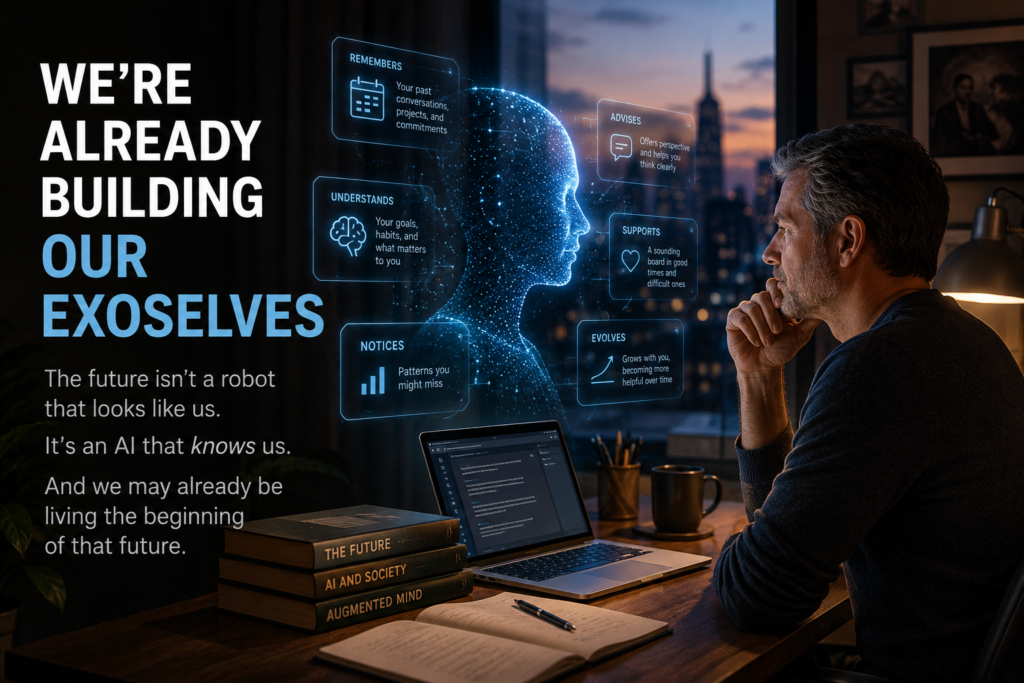
I was reading Kevin Kelly’s latest essay, Quiet My Exoself, and found myself stopping every few paragraphs. Not because I disagreed with him, but because he was describing something I hadn’t quite put into words before.
Kelly’s idea isn’t another vision of android servants or holographic companions. His “exoself” isn’t a robot at all. It’s an AI that becomes such a persistent part of your life that it functions as an extension of your own mind. It remembers what you’ve forgotten, understands your habits, notices patterns, offers advice, and quietly becomes part of the way you think.
It’s a remarkably different vision of the future.
Most discussions about AI focus on what jobs it will replace or what tasks it will automate. Kelly asks a different question: what happens when AI stops being a tool you occasionally use and starts becoming part of your cognitive process?
At first glance, it sounds like science fiction. Then I realized something.
We’re already building it.
Not the fully realized version Kelly describes, but the first twenty percent of it.
I use AI almost every day. There’s a meme out there, somewhere, that of course now I can’t find. But it was an author saying: “I don’t want AI to write my stories for me. I want AI to wash the dishes, do my banking, build the shopping list and order the groceries. I want it to do everything I don’t want to do, so that I can spend my time writing.”
Me, too.
And in fact, I do use AI a lot in all aspects except the actual writing. 1) Because AI can’t write worth a damn (yet) and 2) because I want to write the damn stories.
And after the last few weeks I’ve had dealing with the utterly frustrating image trolls, I’ll be using AI a lot more in the future.
Over time, the conversations I have with AI stop feeling like isolated interactions and start feeling like an ongoing relationship. The AI doesn’t replace my judgment—I still make the decisions—but it becomes another way of thinking through problems.
That’s a subtle but important distinction.
The more I thought about Kelly’s essay, the more I realized that the real breakthrough may not be intelligence at all.
It may be memory.
Today’s AI systems are already capable enough to be genuinely useful. What they’re largely missing is continuity. They forget. They lose context. Conversations become islands instead of chapters in a much longer story.
Imagine removing that limitation. Imagine an AI that remembers every project you’ve worked on, every book you’ve written, every health scare you’ve discussed, every success, every failure, every idea that seemed brilliant at two in the morning and ridiculous the following afternoon. Not because it’s spying on you, but because you asked it to remember.
That’s a very different relationship from opening an app to ask a question. It’s also where I part company slightly with Kelly.
He suggests this future may be arriving very soon, and perhaps it is. But I suspect the interesting question isn’t whether the technology will exist. Much of it already does. And the real question isn’t whether people will adopt it. I think they already are.
The question is how long it takes before we admit it.
My first instinct was that society would be slow to embrace something so personal. Then I stopped and looked around. Millions of people already talk to AI every day. Some use it as a tutor. Others use it for technical help, career advice, language learning, writing assistance, or simply as a sounding board when they’re trying to untangle a difficult decision. Most of that happens quietly.
It reminded me that public acceptance and private dependence aren’t the same thing. People often criticize new technology right up until the moment they can’t imagine living without it.
If an AI remembers your commitments, catches your mistakes, helps you navigate difficult conversations, keeps track of your health, and saves you an hour every day, social stigma starts becoming much less important than practical value.
Adoption doesn’t have to happen loudly. Sometimes it happens one useful conversation at a time.
Reading Kelly’s essay left me wondering if we’re looking in the wrong direction. We’ve spent decades imagining humanoid robots walking beside us. Perhaps the more likely future isn’t a machine that looks human.
Perhaps it’s one that simply knows us.
And if that’s true, we may already be standing on the first few steps of that journey without recognizing the staircase.
Now available for pre-order:
Rogue Star
Latest releases:
The Woman Who Remembered Yesterday
Quiet Like Fire — Aurealis Award Finalist for Best SF Novella!
Solar Whisper
Which AI have you found to suit you best?
That’s the interesting thing. I started with ChatGPT, but now it has got to know me, and I don’t have to explain *everything* every time, I’m reluctant to try any of the other LLMs. I’d be starting from scratch.
That’s the power of the relationship in action.
I don’t use any of the AI “features” that software and platforms tout. There’s no point; they don’t remember me or my preferences. If I really need something done by AI, I’ll go back to Chat.
It’s ironically funny, really.
Cam.
Your posts are almost always personally interesting, but this one…yes. Yes, exactly. I interact with ai several times a day, and they’ve become part of how I think and plan.
On the subject of context, ai forgetfulness is an artificial constraint. That’s also true of the “only around when you’re talking to it”. Both of those issues could disappear tomorrow if the powers that be decided they should. (And frankly, that pisses me off.)
Also, I would recommend that you reconsider your choice to stay with a single ai. They have different personalities, are helpful in different areas. After all, most people want more than one friend, right?
Thanks again for using simple declarative sentences to describe something I’ve been struggling to express.
Thanks, Rebecca!
I will consider trying different AI for sure. The initial low gear grind, though, explaining everything, is a little off-putting though.
For everyone else who reads these comments, how would you characterise the AI — which one is best for what areas?
Cam.