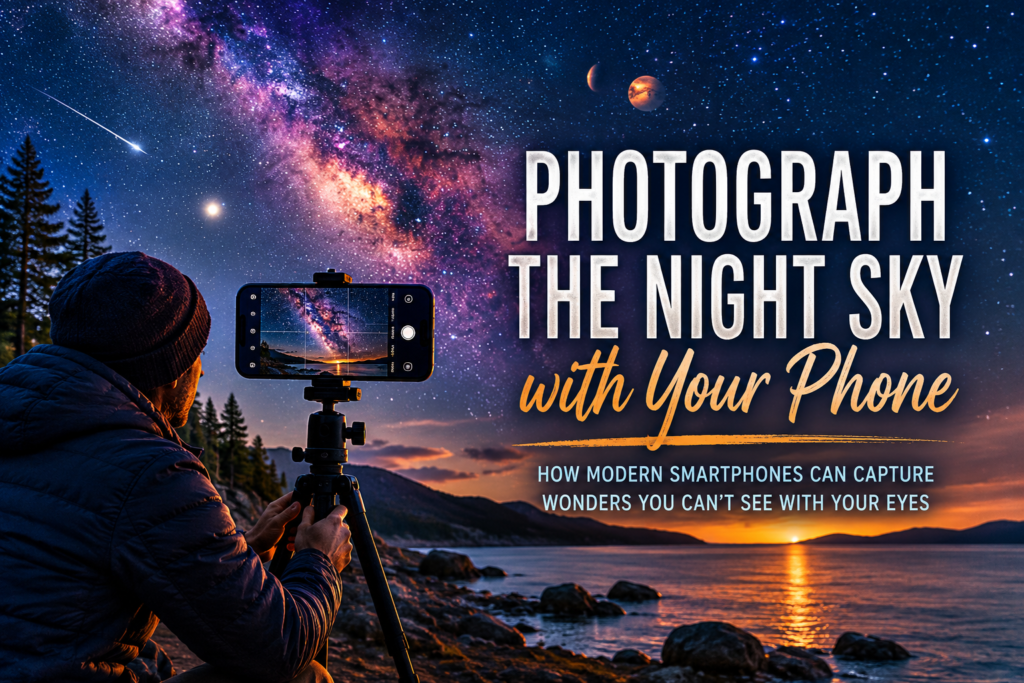
Last year I wrote about using your cellphone to navigate the night sky. Star-mapping apps have become astonishingly good, making it possible to identify planets, constellations, satellites, and deep-sky objects with nothing more than a phone and a few minutes outside.
But something else has changed dramatically over the last decade: smartphones have become surprisingly capable astronomy cameras.
Not too long ago, taking photographs of the night sky with a phone was more of an experiment than a practical hobby. You might capture the Moon if you were patient. A bright planet, perhaps. Anything dimmer was usually a blurry collection of pixels and wishful thinking.
Today, modern phones can capture stars, meteor showers, aurorae, and even sections of the Milky Way. Some can automatically combine dozens of images into a single photograph, pulling details from darkness that are invisible to the naked eye.
The technology is impressive.
The experience is even better.
If you’d like to try it yourself, there are now plenty of excellent guides available online. The basic advice is surprisingly straightforward: find a dark location away from city lights, steady your phone on a tripod or solid surface, activate your phone’s Night Mode or Astrophotography Mode if it has one, and let the software do its work.
Modern phones achieve results that would have seemed impossible a decade ago by taking multiple long exposures and combining them into a single image.
Even if your phone doesn’t include a dedicated astrophotography mode, many phones offer manual controls for exposure, focus, and ISO settings that can dramatically improve night-sky photos. The learning curve is much gentler than most people imagine.
For beginners, the best targets are often the easiest ones: the Moon, bright planets such as Venus and Mars, familiar constellations, and the Milky Way if you’re fortunate enough to live near dark skies. A simple phone tripod costing less than a paperback novel can make a remarkable difference.
What I enjoy most about stargazing isn’t the photography itself. It’s the feeling that comes with looking up.
As a science fiction writer, I spend a great deal of time imagining distant worlds, alien civilizations, and futures that may never exist. Most science fiction readers do something similar. Even if we aren’t amateur astronomers, we tend to have a natural curiosity about what’s out there.
And there is something profoundly different about seeing a real celestial object with your own eyes.
Mars has always been a favourite of mine. Through binoculars or a small telescope, it ceases to be a point of light and becomes a tiny world. You can perceive its shape. It becomes unmistakably a planet.
There is no equivalent sensation like the one you feel when you look up and see planets for yourself.
Photographs in books are wonderful. Space agency images are spectacular. But neither produces quite the same feeling as looking at an actual extraterrestrial object and realizing that the light entering your eyes left that world minutes ago and has crossed millions of kilometres to reach you.
The first time you photograph it with a phone feels almost magical.
You aren’t just looking anymore. You’re bringing home evidence.
The same applies to constellations.
One of the unexpected pleasures of moving between hemispheres is discovering how much of your mental map of the sky is location-dependent. Familiar landmarks shift position. Some disappear entirely. Others appear for the first time.
When I first encountered the Southern Cross, it became the centrepiece of my understanding of the night sky. When I moved to the northern hemisphere, I discovered that what had once occupied the middle of my celestial map was now pushed toward the horizon; or absent altogether.
It’s a reminder that our perspective is always local.
The universe itself doesn’t change.
We do.
Perhaps that’s why stargazing remains so compelling. It constantly challenges our assumptions about scale.
On an average day it’s easy to become absorbed by deadlines, errands, politics, social media, and all the countless concerns that demand our attention. Then you step outside on a clear night and point your phone toward the sky.
Suddenly you’re looking at objects measured not in kilometres but in astronomical units and light-years.
The stars don’t make your problems disappear.
They simply put them into perspective.
For me, that’s one of the great gifts of astronomy. It reminds us of our proper place in the universe. Not in a depressing way, but in a liberating one. We are small, certainly. But we are also part of something unimaginably vast.
And thanks to modern smartphones, it’s easier than ever to capture a small piece of that vastness and keep it with you.
If you’re already using your phone to identify what you’re seeing in the night sky, consider taking the next step and trying to photograph it.
You may not produce images worthy of a space observatory.
But you will create something arguably more valuable: your own record of an encounter with the cosmos.
If you’re looking for a place to start, I’ve included a few current resources below:
- BBC Sky at Night: Smartphone Astrophotography Guide
- Space.com: Best Camera Phones for Astrophotography
- AstroBackyard: Smartphone Astrophotography Basics
Be warned: this may become another hobby. Science fiction readers have always had a tendency to look up at the stars and wonder what’s out there. Modern phones simply make it easier to bring a little piece of that wonder home with you.

Now available for pre-order:
Rogue Star
Latest releases:
The Woman Who Remembered Yesterday
Quiet Like Fire — Aurealis Award Finalist for Best SF Novella!
Solar Whisper