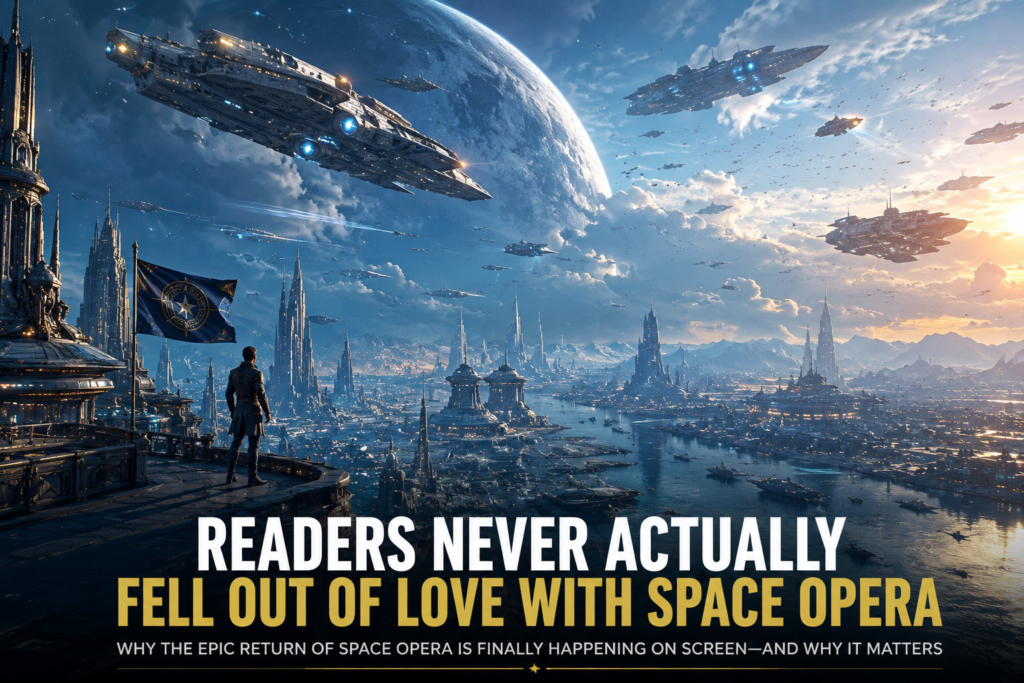
For a while there, it seemed as though science fiction had become embarrassed by adventure.
The dominant mood in modern SF leaned increasingly toward the grim, the dystopian, and the relentlessly serious. Near-future collapse. Oppressive regimes. Corporate nightmares. Stories where the future felt smaller, poorer, and emotionally exhausted.
Some of those stories were excellent. Many still are. But somewhere along the way, a strange narrative emerged: that space opera itself had become old-fashioned. That readers had somehow moved on from starships, galactic empires, frontier worlds, exploration fleets, and civilization-scale storytelling. And yet… readers never actually stopped buying it.
Trust me. I’ve been writing space opera for years. Not only has the audience remained remarkably loyal, but some of my strongest sales consistently come from Apple Books, where readers continue devouring large-scale SF adventures with the kind of enthusiasm publishers sometimes pretend no longer exists. Which suggests something important.
The appetite for big, ambitious, hopeful science fiction never disappeared. It simply drifted outside the narrow corridor of what the industry briefly considered “serious” SF. Now, increasingly, the rest of the entertainment world seems to be catching up.
Space Opera Never Died. It Just Stopped Asking Permission.
One of the more interesting developments over the past few years is the slow but unmistakable return of large-scale science fiction on screen. Not just isolated films, but entire productions built around massive worlds, political complexity, deep lore, interstellar travel, and civilizations stretching across centuries.
You can see it in projects like Dune, (regardless of whatever disagreements people may have about specific creative choices). You can see it in Foundation attempting to tackle galaxy-spanning storytelling once thought impossible to adapt. You can see it in the success and staying power of The Expanse, which proved audiences were absolutely willing to invest in intelligent, sprawling space-based narratives.
Even outside traditional “space opera,” there’s a noticeable shift occurring. Studios and streaming services increasingly seem willing to gamble on scale again. Not just visually, but emotionally. That matters. Because true space opera isn’t merely about spaceships and lasers. It’s about the belief that humanity has a future large enough to contain wonder.
Readers Are Tired of Living at the End of the World
For nearly two decades, dystopian fiction dominated the cultural imagination.
Some of that was understandable. The world has felt unstable for a long time, and fiction often reflects collective anxiety. But after years of collapsing societies, endless cynicism, and stories where civilization itself was treated as inherently corrupt or doomed, audiences appear hungry for something else. Not simplistic optimism. Not naïve utopianism. But scale. Momentum. Possibility.
Readers still want conflict. They still want danger and moral complexity. But increasingly, they also seem to want worlds worth saving. That’s one of the great strengths of space opera. At its best, the genre assumes that humanity survives long enough to matter. That we continue building, exploring, expanding, and reaching outward. Even flawed civilizations in space opera tend to possess ambition. They build fleets. Establish colonies. Create institutions. Preserve knowledge. Push into the unknown.
There’s a reason starships remain such powerful symbols. A starship is optimism with engines.
The Audience Was Always There
One of the things traditional publishing occasionally forgets is that readers do not necessarily organize themselves according to critical fashion. While parts of the industry focused heavily on darker, more intimate, more grounded science fiction, readers quietly continued buying enormous series full of fleet battles, alien mysteries, galactic politics, and frontier exploration.
Indie publishing noticed this long before Hollywood did. So did audiobook listeners, who proved more than willing to immerse themselves in giant interconnected universes spanning ten, fifteen, or twenty books.
Readers were not rejecting space opera. They were simply waiting for creators willing to embrace it unapologetically. And now, slowly but unmistakably, we seem to be entering a moment where larger-scale science fiction is regaining cultural confidence.
Personally, I’m all for it. Give me impossible civilizations. Ancient gates. Dangerous frontiers. Vast empires. Exploration vessels disappearing into the dark between stars. Give me science fiction that remembers the future is supposed to feel big.
And if the jet packs are coming back too, even better. 🙂
Now available for pre-order:
Rogue Star
Latest releases:
The Woman Who Remembered Yesterday
Quiet Like Fire — Aurealis Award Finalist for Best SF Novella!
Solar Whisper
Agreed, but I want to make a point about conflict. Science fiction allows one to imagine never-before-seen challenges, both technological and social. Those challenges don’t necessarily have to be conflicts. Adapting to, or overcoming, those challenges can require inventiveness, cooperation, and other types of newly-imagined technologies and behaviors. Yet so much of space opera is military and conflict-oriented. Even when well-told, they are often missing the real opportunities that science fiction provides.
A particularly egregious recent example is the show ‘La Brea,’ now on Netflix. Here is this group of people hurled into the Pliestocene, without any (or most) of the knowledge, skills or tools to survive–so, facing lots of interesting challenges–and all the writers do is create bogus interpersonal conflicts. I gave up on the show.
Interesting challenges are not all conflicts. In fact, those can be the most interesting types of challenges.
To right. Apocalypses, detailed sexual inter species throbs, super heroes based on gender not intellect and let us not forget the “can a female vampire werewolf find tru happiness with a 6 foot ripped spider being from the (past, destroyed earth,invasion or inter dimensional – pick one)”.
Thanks for understanding and not rewriting soft romance into a scifi novels.
Christoper age 81 not romance reader.
I really enjoy “good” space opera, not the bunch of misfits rammed together stuff though! Cam, your writing is at the top of my list, thanks for a lot of very enjoyable reading and as Chris says keep away from the soft romance stuff.
John age 79 also not a romance fan! Is this an old guy thing?
Gotcha. And I’m chuffed that I’m at the top of your list. 🙂
Cam
PS: It’s not necessarily an old guy thing. I get impatient with stories that were sold to me as, say, fantasy — and most of it is filled with couples therapy disguised as scenes.
If I’m actually reading a romance, that’s different.
It’s the breaking of the implied contract with the reader that I think annoys readers more than anything. There are certain expectations that come along with a genre.
Which is why “acquiring” authors you have learned to trust works so well. You know their brand and what to expect.
Although sometimes even that can let you down if the author doesn’t signal clearly enough that there has been a shift in genre.
(Or, in the case of trad publishers, their marketing team were asleep on the job.)
Cam