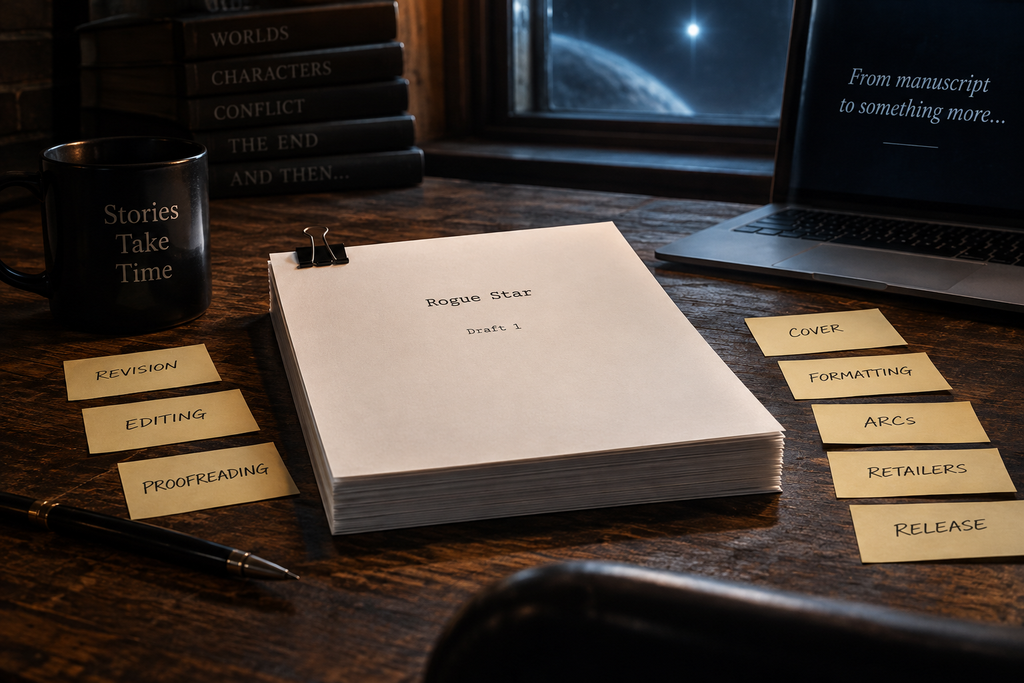
I typed “The End” on Rogue Star.
Well, no, I didn’t. I don’t actually type “The End” at the end of my manuscripts. But the first draft is finished. Rogue Star, book 2 of the Hammer Down series, will be released on November 3. And right now, I have almost nothing to show you.
No cover. No polished excerpts. No shiny finished book I can hold up and say, “Look what I made.” That will all come later. Which got me thinking about something readers don’t often get to see: what happens to a book after the author finishes writing it. Because “finished” is a surprisingly flexible word in publishing.
The Story Is Finished. The Book Isn’t.
When I finish the first draft, I have a complete story. Beginning, middle, end. All the characters have done the things they’re going to do, the explosions have exploded, the secrets have been revealed, and everyone who is going to survive has, presumably, survived. That doesn’t mean the manuscript is ready for you to read.
Now comes the stage where I stop being the person making up the story and start becoming the person responsible for figuring out whether it actually works.
There are things I already know I need to fix. There are probably things I don’t yet know I need to fix. There will be sentences that seemed perfectly reasonable when I wrote them and will cause me to stare at the screen later wondering what on earth I thought I meant. There will be continuity to check. Pacing to examine. Character moments that need another beat—or one fewer. Details planted early in the book that have to match what happens much later.
And, because this is me, there will undoubtedly be commas requiring adult supervision. This is also the point at which other people are permitted to have opinions about my punctuation. Some of them have very strong opinions. They know who they are.
Then Other People Get Involved
This is one of the less visible differences between writing a manuscript and publishing a book. At some point, the author has to let other people touch it.
Editors read it with different eyes. A copyeditor notices things I’ve become incapable of seeing because I know what the sentence is supposed to say. Proofreading catches another layer of problems after the manuscript has been turned into something that actually looks like a book. And every time the manuscript changes form, there is another opportunity for something peculiar to happen.
Meanwhile, work is happening on everything that surrounds the words themselves. The cover has to be finalized. The book has to be formatted. The ebook has to be built. The print edition has to be laid out. The description has to be written. Advance copies have to go out. Retailers need information. Files need to be uploaded, checked, corrected, and sometimes uploaded again.
There are a remarkable number of steps between “I finished writing a book” and “you can buy the book.” My current production checklist that walks me through that process has over 200 tasks.
So Why November 3?
Because all of that takes time. From the outside, it can look as though a finished manuscript sits around for a few months while everyone waits for release day. It doesn’t. Between now and November 3, Rogue Star will gradually stop being a manuscript on my computer and become the book you’ll eventually see.
Somewhere along the way, I’ll be able to show you the cover. Then I’ll have more to tell you about the story itself. There will be excerpts and other bits and pieces as we get closer.
But today, it’s still mostly a manuscript. A finished manuscript. And after living with this story for as long as I have, I’m going to enjoy saying that for at least a little while.
Rogue Star is coming November 3. More soon.
Latest releases:
The Woman Who Remembered Yesterday
Quiet Like Fire — Aurealis Award Finalist for Best SF Novella!
Solar Whisper