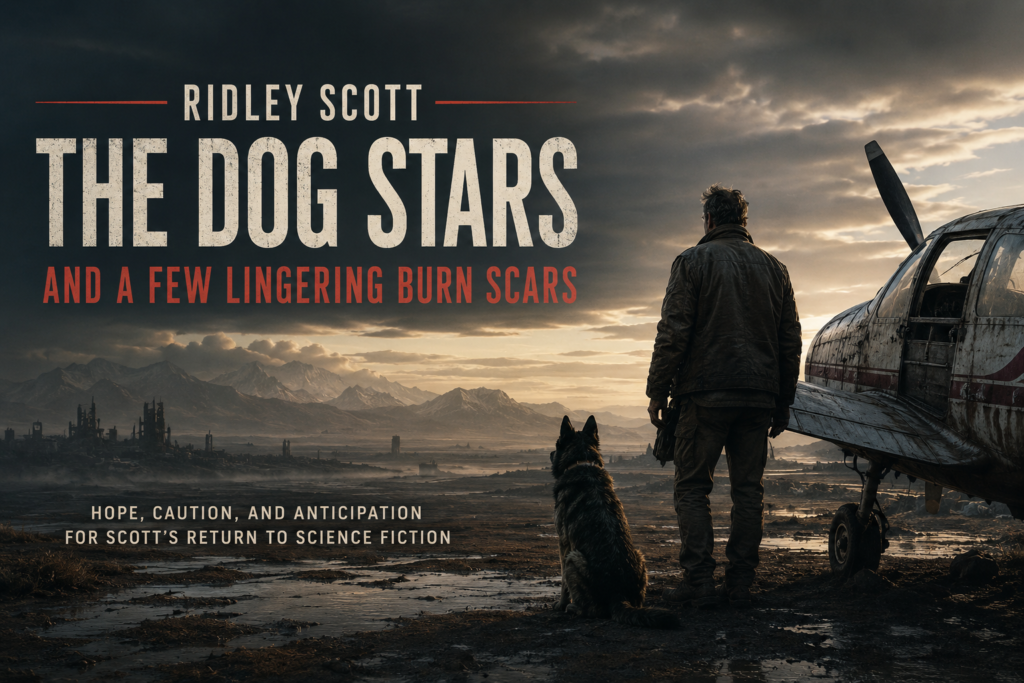
Ridley Scott is one of my favourite directors. Most of his movies are automatic watches for me. When a new Scott film appears on the release calendar, it jumps straight to the top of the queue. No questions asked.
Well. Almost no questions.
Because Gladiator II happened. But, we’re not going there. Not much, anyway.
Scott has returned to science fiction with The Dog Stars, based on Peter Heller’s 2012 novel. The official trailer landed recently, and on the strength of those few minutes alone, I’m interested. Very interested.
One of the things that stood out to me was the apparent emphasis on relationships. Yes, there’s the post-apocalyptic setting, the loneliness, the danger, and all the usual ingredients. But the trailer seems far more interested in the people inhabiting that world than the world itself.
That’s usually a good sign.
Scott has always been remarkably good at identifying the emotional heart of a story and bringing it to the screen. Whether it’s the crew of the Nostromo in Alien, Roy Batty’s search for meaning in Blade Runner, or Mark Watney’s determination to survive in The Martian, the human element is often what elevates his science fiction above spectacle.
And Scott understands atmosphere. His science fiction films don’t just tell stories. They create moods. The industrial grime of Alien. The rain-soaked melancholy of Blade Runner. The eerie grandeur of Prometheus. Even when the stories themselves divide audiences, the worlds linger in the imagination.
That’s a rare talent.
Which brings me back to Gladiator II.
I’m not interested in relitigating the film, but I’d be lying if I said it didn’t leave me wary. What surprised me wasn’t that it departed from historical fact. Scott has always taken liberties with history. Most filmmakers do.
The issue was that it felt oddly uncharacteristic. The confidence and coherence that usually underpin a Scott production seemed absent. It wasn’t merely inaccurate. It felt uncertain of what it wanted to be. The ending was disappointing.
As a result, The Dog Stars arrives carrying baggage that has nothing to do with Peter Heller’s novel.
And speaking of the novel, I’d somehow never heard of it until the trailer appeared, despite the book being published back in 2012—which, in movie development terms, feels like several geological eras ago. Apparently it was very well received. That helps.
[Since writing this, I sampled the novel on Amazon. I can see why it attracted critical attention, but the prose style didn’t immediately click with me. It’s highly fragmented and impressionistic, which some readers will undoubtedly love. Still, a film adaptation doesn’t have to reproduce a novel’s narrative voice to capture its emotional core, and that’s where Scott’s strengths as a filmmaker may prove most valuable.]
The other conversation I’ve seen recently revolves around Scott himself. Every time he announces a new project, someone marvels that he’s still directing major studio films in his late eighties.
It’s an extraordinary achievement.
But I don’t think one disappointing film is evidence that he should hang up the camera. Great directors have always made uneven movies. Scott’s own filmography has never followed a straight line from masterpiece to masterpiece. For every universally acclaimed classic, there’s usually a more divisive title sitting nearby.
That’s been true for decades.
What keeps me showing up is that even his lesser films tend to be ambitious. They aim high. They try things. Sometimes they miss, but they’re rarely dull. And if there’s one genre where Scott has earned the benefit of the doubt, it’s science fiction.
So here I am, cautiously optimistic. The trailer looks good. The source material has a strong reputation. The emphasis appears to be on character and relationships rather than endless spectacle.
All positive signs.
Still, when I eventually sit down to watch The Dog Stars, I’ll admit that a small part of me will be waiting to see whether Ridley Scott still has the magic. I hope he does. I’d like to keep auto-watching Ridley Scott movies for a few more years yet.
Now available for pre-order:
Rogue Star
Latest releases:
The Woman Who Remembered Yesterday
Quiet Like Fire — Aurealis Award Finalist for Best SF Novella!
Solar Whisper