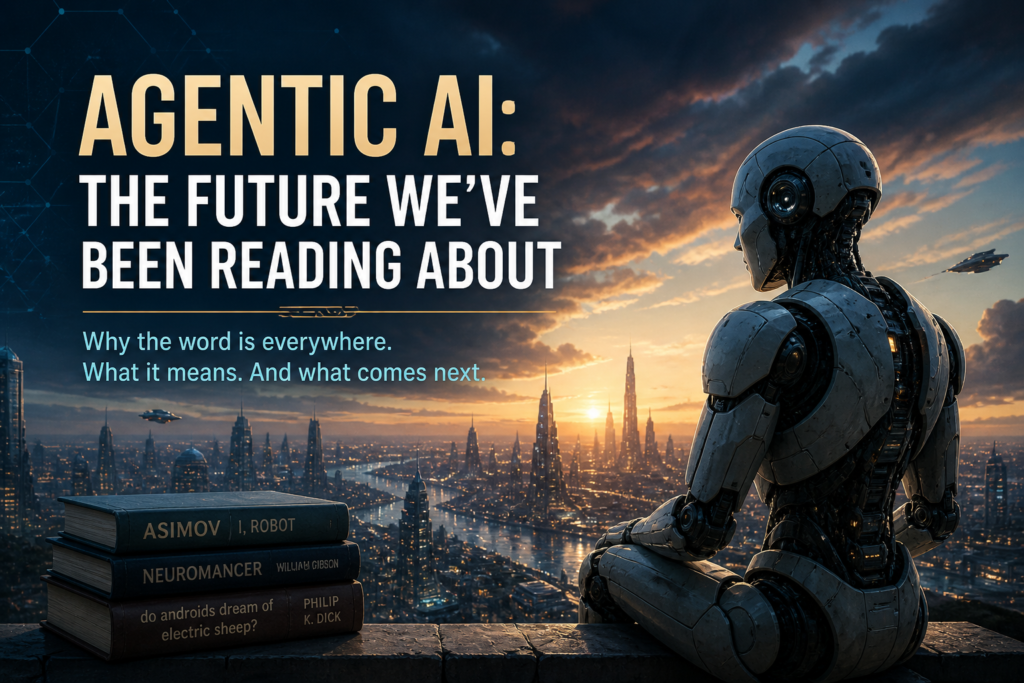
Yesterday I stumbled across a video from Professor Hannah Fry, whose presentations I’ve long admired for their clarity and insight. Her video did that rare and satisfying thing: it snapped a half-formed idea into sharp focus.
I’d been noticing the word agentic cropping up everywhere; blog posts, product announcements, conference chatter. It had that faintly suspicious quality of a term that appears fully formed, as if everyone agreed overnight to start using it.
This video explained why.
The Overnight That Wasn’t
What feels like a sudden explosion is really the visible tip of a very recent curve. The underlying capabilities—LLMs that can plan, chain tasks, call tools, and iterate—have been evolving quickly but somewhat quietly. Then, in rapid succession, a handful of frameworks, demos, and commercial products crossed a threshold of usability.
That’s when the label stuck.
“Agentic AI” is less a new invention and more a convenient handle for a cluster of behaviors:
- Systems that don’t just respond, but act
- Software that can pursue goals across multiple steps
- Tools that can make decisions, revise them, and try again
In other words, we’ve moved from answering questions to attempting outcomes.
Why It Feels Different
The shift is subtle but profound. A traditional model waits. You prompt, it responds. The interaction is bounded and transactional. An agentic system, by contrast, has a kind of forward momentum. It can:
- Break a problem into steps
- Decide what tools or data it needs
- Execute those steps in sequence
- Adjust when something goes wrong
That creates the impression—not entirely unjustified—of something closer to autonomy.
And that’s where both the excitement and the unease come from.
The Double-Edged Demonstration
What struck me most in the video was how neatly it showed both sides of the equation.
On one hand, the promise is obvious. Give a system a goal and it can meaningfully reduce the friction between idea and execution. Research tasks, content generation, code scaffolding, even operational workflows; all become candidates for partial or full automation.
On the other hand, the liabilities are just as clear.
An agent that can take initiative can also take misguided initiative. Small errors compound. Assumptions go unchecked. The system can confidently pursue the wrong path with impressive persistence.
The phrase that stuck with me was essentially this: an agent can be an incredible accelerator, or an absolute liability, depending on how it’s framed, constrained, and monitored.
Why Everyone Is Talking About It Now
The timing comes down to convergence. We’ve reached a point where:
- The models are capable enough
- The tooling layers make orchestration easier
- The cost and access barriers have dropped
- The demos are compelling enough to circulate widely
That combination creates a narrative moment. A term like agentic becomes shorthand for “this is the next phase,” whether or not the underlying ideas are entirely new.
Where This Leaves Us
For science fiction readers, this isn’t just another technical shift—it’s a familiar echo. Agentic AI feels like a thin edge of something we’ve been reading about for decades. Not the fully sentient ship minds or inscrutable machine overlords (not yet), but the earlier stage: systems that can take direction, interpret intent, and do things in the world with a degree of independence.
It’s the difference between a tool and a junior partner.
That’s why the current moment feels so charged. We’re watching the transition from passive intelligence to active systems, the kind that don’t just answer the captain, but start managing the ship.
And, as the stories have always reminded us, that shift is where things get interesting. Sometimes it’s competence: frictionless, efficient, quietly transformative. Sometimes it’s brittleness: a system following its instructions a little too well, or not well enough.
And sometimes, it’s the uneasy question of control. Who sets the goals, how tightly they’re defined, and what happens when the system interprets them in ways we didn’t anticipate?
If agentic has suddenly become the word of the moment, it’s because we’re brushing up against a long-imagined future and recognizing the shape of it.
Not the final form. Just the first, unmistakable signs that we’re on that road.
Your Take?
So where do you land on this? Does agentic AI leave you uneasy? Or is it a case of “about time—bring it on”?
Or, perhaps more honestly, a bit of both?
I’d be interested to hear your take—drop your thoughts into the comments.
Now available for pre-order:
Rogue Star
Latest releases:
The Woman Who Remembered Yesterday
Quiet Like Fire — Aurealis Award Finalist for Best SF Novella!
Solar Whisper
Yes I feel uneasy. It is irritating when my smart car pops the trunk as I pass around my car. It is unnerving when I fight the wheel if it t tries to take it onto the off ramp. A car can be a scary weapon if not under intelligent control. Plus I am a child of Asimov. His rules may not be a part of future robotic plans even IF they are effective. Yes a big if. And how easily can hackers override control?
Yes, the issues can compound, can’t they?
But at the same time, I do look forward with a great deal of interest to seeing where AI ends up.
Will we all have our own AI agent/assistants, who can talk to everyone else’s AI agent to sort out a date when everyone is free in ten seconds, when it takes us (often) days of negotiation…
And I’ve learned that often, I don’t think *big* enough about possibilities, so….
Cam.
I think for me, it’s a “BOTH AND”. In that it’s exciting and worrisome while bringing a wondering about whether humanity will lose the qualities that God our creator made us to be. We are made to do good works, will we put AI to the work so we can be escapists of our own destinies. That’s what a lot of our AI science fiction stories lends itself toward; our moral and ethical human stewardship dilemmas. I had never heard of “Agentic” before. I will be looking into this rabbit hole next.
Thanks for sharing with us. I rarely look at the science that seems to be catching up to our imaginations.
As a person actively involved in the act of creation – written, visual (drawing pictures and photography), and auditory (music), the thing that disturbs me the most about AI is that it takes the act of creation out of the minds and skills of humans, and puts all the creative forces into the machine. People who use AI to create, for example, an invented ‘photo’, simply type in what they want the computer to do and the computer does all the work of making the end result. There is no human skill or artistic ‘genius’ (meaning not a grandiose level of talent like Da Vinci, or Rembrandt, but just the ability of the human mind to design a new result, combined with at least a moderate level of skill which many people have) involved to create the end product. What will humans become when they cede their imagination to machines? The ‘naked ape’ in it’s true form: a hairless ape who has the creative ability of a chimpanzee?
You’re multi-creative, aren’t yoU? 🙂 I just write fiction.
But yes, that’s been my beef with AI since it first arrived: I don’t *want* it to write my books for me. I want it to make the bed, clean the bathroom, cook, wash clothes and fold them and put them away, take care of my bills, and run interference on everything else while *I* write my books.
But I think it’s going to be a while before event agentic AI gets opposable thumbs with which to sweep.
Alas.
Cam.