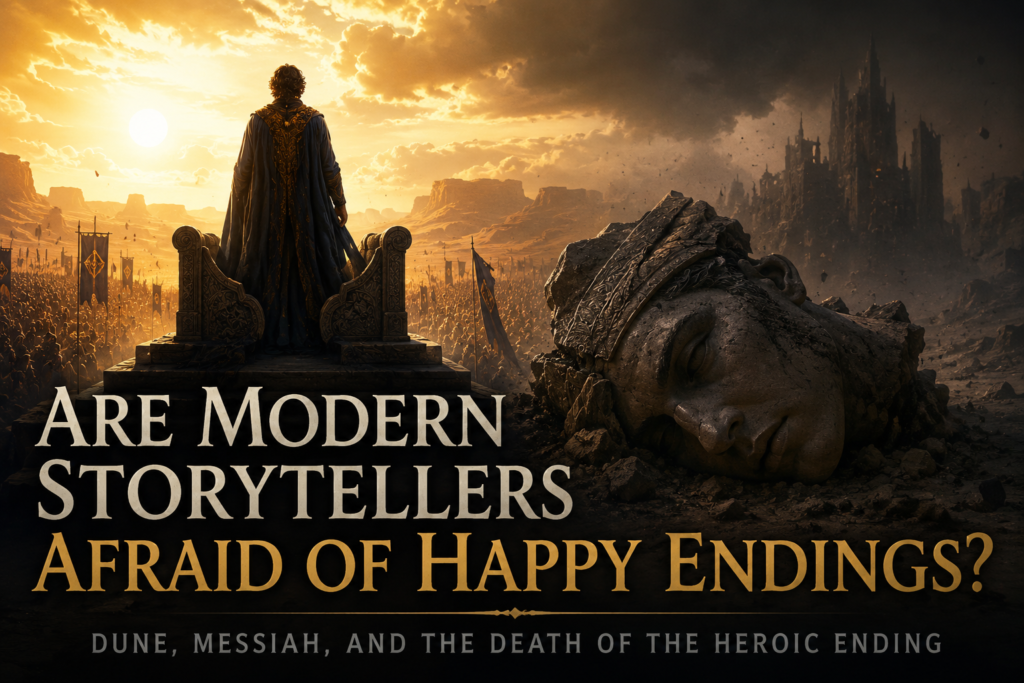
The new Dune 3 trailer dropped, and instead of excitement, I felt something closer to wariness. Not because the filmmaking looks bad. Quite the opposite.
Denis Villeneuve has crafted visually stunning films. The pacing is excellent. The emotional beats land. The atmosphere is immersive. The cast is extraordinary. As pure cinema, the first two Dune films are impressive achievements.
But as I watched the trailer, I realized what was bothering me. I’m increasingly convinced that modern science fiction no longer trusts heroic endings.
Dune Was a Complete Story
One thing modern audiences sometimes forget is that Frank Herbert’s original Dune works perfectly well as a standalone novel. Its structure is almost classical in its symmetry:
- Arrival on Arrakis
- Integration with the Fremen
- Confrontation with the Emperor
The emotional arc is equally classical; the fallen house, the exiled heir, transformation through hardship, mastery, victory, and finally, restoration.
Yes, Herbert seeded warnings throughout the novel. The danger of messianic worship is there from the beginning. The possibility of jihad shadows Paul’s rise. Herbert was never writing simplistic hero worship. But emotionally, Dune still lands as triumphant.
That matters.
Readers spend hundreds of pages watching Paul Atreides rise from hunted refugee to Emperor. The story earns its mythic scale honestly. The reader is allowed to feel the exhilaration of that ascent.
And I think Villeneuve understood that perfectly. Which is why I don’t believe he misunderstood Dune at all.
The Messiah Problem
The problem is that Villeneuve also clearly understands Dune Messiah. Possibly too well.
There’s a short epigraph in Messiah that may summarize the entire novel better than anything else Herbert wrote:
Here lies a toppled god,
His fall was not a short one.
We did but build his pedestal,
A narrow and a tall one.
That is not the epigraph of a triumphant space opera. It is the epitaph of a fallen messiah. And that changes everything. Dune Messiah is not a continuation of heroic triumph. It is a deconstruction of it. Herbert essentially turns around and asks the reader: What happens after humanity places a savior on a pedestal?
The answer is neither comforting nor uplifting.
Flattening the Rise
This is where Villeneuve’s adaptation choices become fascinating. Throughout Dune: Part Two, he consistently undercuts Paul’s triumph. Chani’s skepticism is amplified. The prophecy aspect is framed primarily as manipulation. The Fremen fanaticism is brought forward and amplified. That makes Paul’s victory feels ominous instead of transcendent.
By the end of the film, the emotional tone already resembles Messiah far more than Dune. And that’s where my unease comes from. Not because the films are poorly made, but because I think Villeneuve flattened the emotional rise too early.
In story terms, tragedy requires height. The pedestal matters because the fall matters. If Paul never truly ascends emotionally in the eyes of the audience, then his eventual collapse loses scale. Instead of:
- rise
- triumph
- corruption
- tragedy
…the story becomes:
- uneasy rise
- compromised victory
- continuing collapse
The contrast weakens. Classical tragedy is not “everything was miserable from the beginning.” It is greatness becoming ruin. King Arthur’s Camelot had twenty years of peace and glorious plenty before it fell to the Saxons. Michael Corleone was as a moral man, who rose to the head of the even-more-powerful Corleone family. His consolidation of power feels triumphant, which is precisely why his eventual spiritual collapse is devastating.
Frank Herbert understood this perfectly. He allowed readers to love Paul first. Only afterward did he interrogate that love.
Herbert’s structure only fully works if readers emotionally buy into Paul’s legitimacy, his transformation, triumph and near-divinity first. Messiah then weaponizes that emotional investment against the reader.
Villenueve may be diminishing the eventual tragedy by preemptively warning audiences not to admire Paul too much.
Modern storytelling often seems uncomfortable allowing that first step to happen sincerely.
Are Modern Storytellers Afraid of Heroism?
Which raises the larger question I kept circling back to after the trailer ended: Have modern storytellers become afraid of genuinely heroic endings? Modern prestige science fiction often defaults toward ambiguity, corruption, moral decay, compromised victories and tragic inevitability
Somewhere along the way, optimism began to be treated as naïve. Heroism became suspicious. Happy endings became unsophisticated.
And this creates an interesting feedback loop.
Studios and publishers see dark stories succeed, so they produce more dark stories. Audiences consume those stories because those are the stories available. Which then reinforces the belief that audiences only want grim narratives.
But do they? I’m not convinced.
Audiences Still Love Hope
Look at Star Wars.
The original film was almost aggressively sincere. It believed in heroes. It believed courage mattered. It believed evil could be defeated. It ended in triumph without irony or apology.
Audiences didn’t reject that sincerity. They embraced it. Massively.
The same is true of The Lord of the Rings. Or Star Trek: The Next Generation. Or The Martian.
Audiences do not reject hopeful stories. They reject badly written ones. There is a difference.
And I sometimes wonder whether modern creators have become so concerned about appearing simplistic that they undercut their own victories before audiences are even allowed to experience them fully.
Why This Matters to Me
This is probably one reason my own science fiction sits slightly outside current trends.
I’ve never been especially interested in noir futures or bleak endings for their own sake. I don’t think darkness automatically creates depth. I don’t think cynicism is the same thing as sophistication.
That doesn’t mean stories should be consequence-free. It doesn’t mean heroes should never fail. But I still believe courage should matter. Sacrifice should mean something. Victories should occasionally remain victories.
And perhaps most importantly, I think readers still hunger for stories that leave them looking upward instead of downward.
I’ll Still Watch Dune 3
Of course I will. Villeneuve is too gifted a filmmaker for me not to watch the conclusion of his trilogy. But for the first time, I’m watching with caution instead of anticipation.
Not because I fear bad filmmaking. Because I fear we’ve reached a point where modern science fiction no longer believes heroes are allowed to win.
Latest releases:
The Woman Who Remembered Yesterday
Quiet Like Fire — Aurealis Award Finalist for Best SF Novella!
Solar Whisper