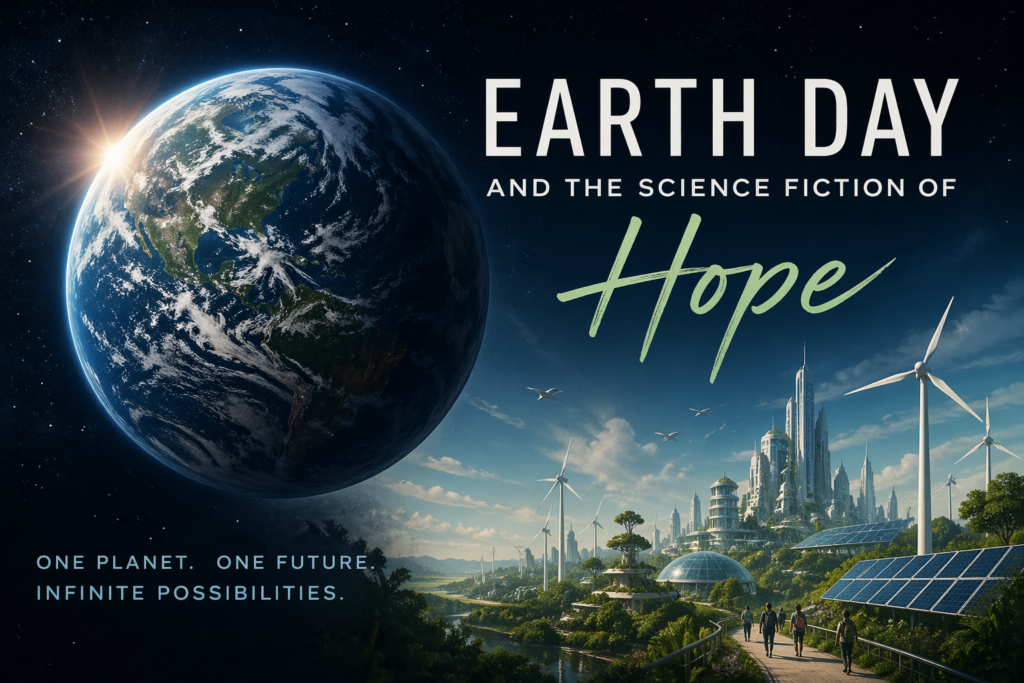
Every year, Earth Day (that’s today) asks us to pause and think about the world we are leaving behind for the next generation. It is a day about environmental protection, certainly, but it is also about imagination. About asking what kind of future we want.
Science fiction has been asking that question for a very long time.
More often than not, SF begins with a warning. Strip away the spaceships and ray guns, and so many post-apocalyptic stories are really environmental stories. The poisoned wastelands, drowned cities, burning skies, and desperate survivors all come from one place: humanity failed to protect the world that made us.
We can all name dozens of examples without even trying. Entire branches of science fiction are built on the idea that environmental neglect leads to collapse. Climate catastrophe, exhausted resources, ruined ecosystems—these are some of the genre’s oldest and most persistent fears.
But SF has never been only about fear.
The Other Side of Environmental Science Fiction
If post-apocalyptic SF is the cautionary tale, then Solarpunk and Hopepunk are the answer.
These stories imagine a future in which humanity does not simply survive environmental collapse, but avoids it. They imagine people who build instead of destroy. Communities that cooperate. Technology that works with nature instead of against it.
Environmental protection is at the heart of Solarpunk. It is the genre’s foundation, its reason for existing.
That is one reason why I think these stories matter so much right now. They remind us that there is another path. We are not trapped in the darker futures that so much fiction warns us about.
My own Winds of Change belongs very much in that tradition. It is a story built on the belief that human beings can do better. That science, ingenuity, and determination can solve the problems we create. That there is still time to choose a future worth living in.
Frank Herbert and the Ecology of the Future
Long before Solarpunk had a name, Frank Herbert was exploring the relationship between humanity and the environment.
Dune is often remembered for its politics, religion, and empire-building, but at its heart it is an ecological novel. Herbert understood that environments shape civilizations. The harshness of Arrakis created the Fremen. Scarcity shaped their values, their culture, and their dreams.
More importantly, Herbert showed that environments can be changed.
The dream of transforming Arrakis into a living world runs through the entire story. It is ambitious, dangerous, and controversial, but it is also hopeful. It says that humanity is not powerless in the face of environmental crisis.
Herbert was not the first writer to explore these themes, though he may have been the one who brought them into the center of science fiction. Earlier writers warned about poisoned worlds, overpopulation, and environmental ruin. But Herbert raised the stakes. He made ecology inseparable from the story itself.
Since then, countless writers have followed where he led.
Science Fiction’s Greatest Hope
There is one more kind of hope hidden inside almost every science fiction story.
No matter how dark the setting, no matter how badly Earth has been damaged, science fiction usually assumes one thing: humanity has a future.
Sometimes that future is here on Earth. Sometimes it lies among the stars.
Every SF story about the Moon, Mars, orbital habitats, or distant planets carries the same quiet promise—that one day we will no longer depend on one small world alone. That we will learn how to live elsewhere in the solar system, and perhaps beyond.
That does not mean abandoning Earth. Quite the opposite.
The better we become at protecting and sustaining our own planet, the better prepared we will be to carry that knowledge with us. Learning to live responsibly on Earth is practice for learning to live anywhere.
Right now, we are still playing Russian Roulette with one lonely blue marble.
But perhaps the deepest optimism in science fiction is this: we do not have to stay that way forever.

Now available for pre-order:
Rogue Star
Latest releases:
The Woman Who Remembered Yesterday
Quiet Like Fire — Aurealis Award Finalist for Best SF Novella!
Solar Whisper
I loved this!
Thank you!
Cam.