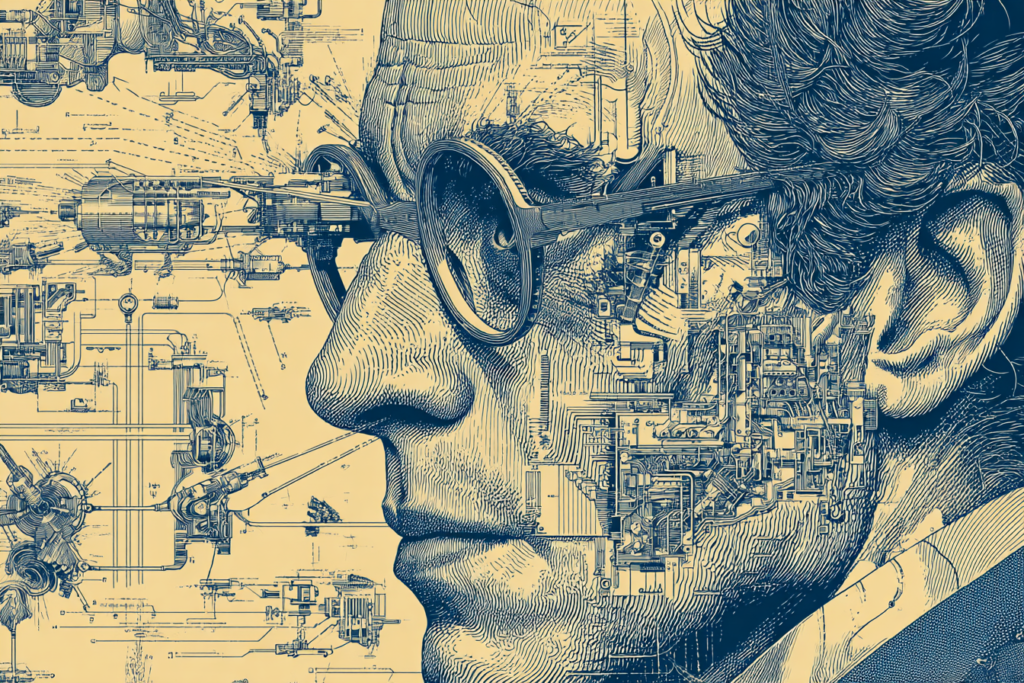
Every so often, the Singularity drifts back into the conversation—especially in the tech corners of the internet. This week, Kevin Kelly, co-founder of Wired and a long-time observer of technology’s trajectory, published a piece on Substack suggesting that the Singularity is much further off than Ray Kurzweil would have us believe.
I haven’t had a chance to dig into the full article yet, but even the headline was enough to pull me back into a question I’ve long circled: is the Singularity coming, and if so, what will it actually look like when it arrives?
What is the Singularity, exactly? It’s a term coined by mathematician and science fiction author Vernor Vinge, and later popularized by futurist Ray Kurzweil. In essence, it refers to a hypothetical future moment when artificial intelligence becomes smarter than humans and begins to improve itself at an accelerating rate—triggering radical, unpredictable changes in society, technology, and even human biology. Some imagine it as a kind of technological tipping point. Others see it as a process already in motion.
Here’s a quick look at the two competing visions—and where I land on the spectrum.
Kurzweil’s Vision: The Big Leap
Ray Kurzweil has been predicting a technological singularity for decades now. His premise: that AI will eventually surpass human intelligence, triggering a runaway feedback loop of self-improvement. In this vision, around the year 2045, humanity hits a kind of cosmic tipping point where intelligence explodes, biology merges with machinery, and civilization as we know it transforms almost overnight.
He outlines this future in The Singularity Is Near (2005), and expands on it in this year’s The Singularity Is Nearer. His forecasts rely on the Law of Accelerating Returns—the idea that technological progress builds exponentially, not linearly.
In Kurzweil’s future, we’re on the brink of a rapid, irreversible shift.
Kevin Kelly’s Take: It’s a Process, Not a Moment
Kevin Kelly, on the other hand, offers a slower, more measured view. He doesn’t deny that AI and emerging technologies are changing the world. But he challenges the idea that there will be a sudden, visible “before and after” moment we’ll call the Singularity.
Instead, he sees a world where dozens—perhaps hundreds—of narrow, specialized AIs gradually infiltrate daily life. Intelligence will be distributed, not centralized in a single godlike mind. Progress will be uneven. Society will adjust slowly and imperfectly. It’ll be messy.
Kelly’s vision isn’t less radical—it’s just less cinematic. The Singularity, in his view, will be a long, complex transition we may not fully recognize until it’s already behind us.
I Asked ChatGPT What It Thinks
Since this is one of those questions that blurs the line between science fiction and real-world speculation, I asked ChatGPT for its take. As an AI, I wasn’t even sure if it would have an opinion. Surprisingly, it did.
Here’s what it said:
“I think the singularity will be real—but it won’t be sudden, clean, or apocalyptic. It will unfold over decades, unevenly, quietly, and with all the messiness of human society trying to catch up.”
“You might wake up one day in 2047 and realize we passed the singularity a decade ago—and nobody noticed.”
I’ll be honest: I agree.
We’re already watching AI ripple across art, science, medicine, and communication. Not always replacing humans, but reshaping how we work, think, and create. This isn’t the Singularity as Kurzweil imagines it—but it may be the beginning of the shift.
My Take: The Singularity Will Be Uneven, Invisible, and Human-Shaped
I don’t think we’ll see a single moment where AI becomes superintelligent and everything changes overnight. What seems more likely is a drawn-out, irregular evolution—something that feels very human in its texture.
Some places will charge ahead with AI adoption. Others will resist or lag behind. Some parts of life will transform completely. Others will look much the same as they always have.
The technology may leap forward. But society moves at the speed of people.
We might not get flying cars and virtual immortality. We might get frictionless bureaucracy, AI-authored legal documents, personalized education that works, or a hundred invisible shifts that quietly reshape our experience.
Final Thought: The Future Is Unevenly Distributed
William Gibson once said, “The future is already here—it’s just not evenly distributed.” That may turn out to be the most accurate prediction about the Singularity yet.
Whatever shape it takes, the next few decades won’t be defined by a single moment. They’ll be made up of a thousand small revolutions happening at different speeds, in different places, for different people.
And those are the kinds of futures I like to write about.
Pre-order now:
The Woman Who Remembered Yesterday
Latest releases:
Quiet Like Fire — Aurealis Award Finalist for Best SF Novella!
Solar Whisper
Ptolemy Lane Tales Omnibus
I have to say I just finished reading about an AI driven vending machine that was a laugh out loud failure for the Wall Street Journal office it was placed in. A funny outcome but it shows that the Singularity is not happening anytime soon. At least for now.
And then you look at vending machines in Japan and wonder…
https://www.youtube.com/watch?v=STbldaOzN_4