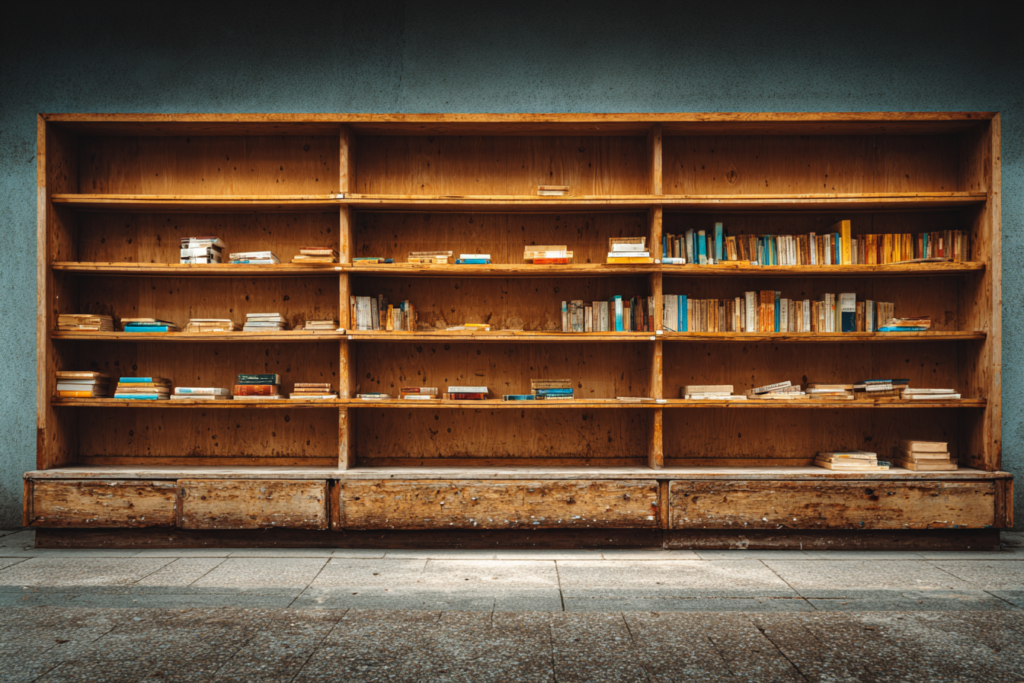
Readers often assume the digital age solved a lot of old-world problems in publishing.
- No shelf space limits.
- No warehouse bottlenecks.
- No “we only stock the top 1% of books” gatekeeping.
In theory, an online bookstore should be the perfect expression of abundance: Infinite shelves, infinite choice. A paradise for niche genres and long-tail backlists.
And yet—here we are.
Over the past few months, Barnes & Noble has been quietly “unpublishing” titles that don’t meet their visibility or sales thresholds. Books simply vanish. Sometimes permanently. Sometimes temporarily. They don’t inform the indie author.
And, more interestingly, sales across the board for a lot of indie authors dropped almost overnight.
That kind of sudden collapse usually isn’t reader behavior. It’s an algorithm realignment.
If you browse B&N lately, you may notice the pattern: indie titles are harder to find, harder to surface, harder to stumble across. The long tail–the bread-and-butter of digital reading culture–is shrinking.
This isn’t unique to B&N. Every centralized platform eventually follows the same evolutionary arc:
- Start wide (big catalog, open gates, lots of diversity).
- Grow fast (the long tail drives traffic).
- Panic about quality, consistency, and identity.
- Retrench (limit inventory, boost curated picks, narrow what counts as “sellable”).
- Gatekeep (algorithmic suppression, increased policing, corporate caution).
It’s a pattern of consolidation, not malice. Platforms want predictable profit, not the messy abundance readers actually enjoy.
But here’s why this matters to you as a reader:
When a retailer shrinks its shelves, you lose access.
- Books disappear.
- Backlists fade.
- Series become incomplete.
- Genres get “cleaned up.”
And what remains is whatever the platform deems “worthy,” “safe,” or “profitable enough.”
If you’ve ever wondered why your favorite series suddenly stops at Book Three on a retailer, even though the author wrote six more, this is why.
The good news? You’re not at the mercy of anyone’s algorithm. Not Amazon’s. Not Kobo’s. Not Barnes & Noble’s. Nor any corporation’s idea of “acceptable inventory.” You always have the option to go direct.
Buying direct from authors or small presses:
- gives you permanent files
- lets you choose your format
- bypasses disappearing retail listings
- keeps series intact
- often gets you bonus content or discounts
- ensures you can read the book on any device
- cuts out a lot of middle layers that don’t add value to your reading life
And for what it’s worth: authors notice, appreciate, and remember their direct buyers. You become part of the ecosystem, not a ghost behind a retailer’s firewall.
None of this is a plea for you to stop using B&N or any other store. Use whatever platform works for you. But it’s worth understanding what’s happening behind the storefront glass, especially when long-tail books begin vanishing and algorithms shift without warning.
The truth is simple: Retailers will come and go. Algorithms will rise and fall.
But direct access between writers and readers? That sticks around.
As long as you want my books, you’ll always be able to find them, in full, in order, unpurged, unhidden, and right from the source. The shelves there never shrink.
Pre-order now:
The Woman Who Remembered Yesterday
Latest releases:
Quiet Like Fire — Aurealis Award Finalist for Best SF Novella!
Solar Whisper
Ptolemy Lane Tales Omnibus
I think buying directly from the author is always best! The author gets the best deal and the reader has access to all purchases. And supporting indie authors is essential to keeping variety and interest alive! Great post, Cameron!
Thanks, Charlie!
Being platform agnostic opens up a world of possibilities, for sure. There’s a lot of books that don’t make it onto the retail stores. And buying direct gives you the connection with the author, too.
Cam.
Buying direct from the author is best, because then I actually own the books. If I buy it, I want to keep it! How sad is it that my large Kindle library is no longer actually mine. Licensed for my use does not mean I own the books. I can no longer download my library to back it up to my local laptop for safekeeping and organizing, at least for now. Not to mention libraries are not always carrying books I want. Hooray for indie authors like you and your online bookstore.
It’s not just your Kindle library that isn’t yours, Kat. It’s any of the retail stores.
Although at the moment, you *can* download your Kindle library: Amazon just reversed their decision on this. But I don’t know how long the situation will hold. This is why I wrote this post. Now is a very good time to start bringing your library down to your hard drive.
Cheers,
Cam.